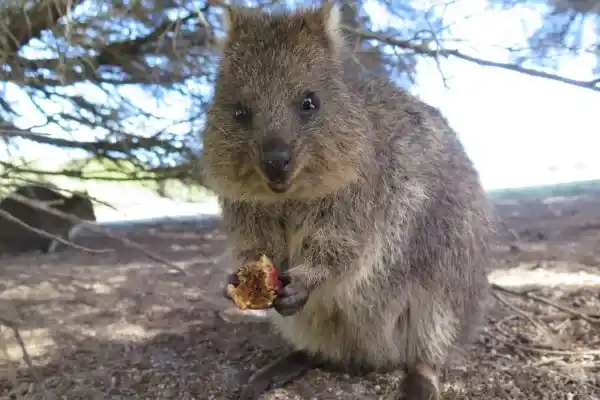
Have you ever seen this smiling little animal? The quokka (scientific name Setonix brachyurus ) has been called the "world's happiest animal" since 2013 because it looks like it's always smiling. With its endearing appearance and unique smile, it quickly became a social media sensation and a must-see for many tourists visiting Australia. People eagerly take photos with them, making the quokka a global "internet celebrity."
Next, we will give you a comprehensive introduction to the distribution, lifespan, physical characteristics, personality traits , and the survival threats they currently face.
Distribution and lifespan of the Quokka
Quokkas are endemic to Western Australia, primarily found on Rottnest Island and Bald Island . Interestingly, the island's name originates from them. In the late 17th century, explorer William Dampier first encountered these animals on the island and mistook them for large rats, thus naming the island Rattennest (meaning "rat's nest") in Dutch. This name later evolved into the current Rottnest.
Rottnest Island has become a popular tourist destination because of the quokka, attracting many visitors who come just to take a selfie with "the happiest animal in the world".
Quokkas have an average lifespan of about 10 years in the wild. They are nocturnal herbivores , mostly resting during the day and more active in the evening and at night. They mainly feed on leaves and grass, obtaining most of their water from their food, thus they can survive even during prolonged periods of water scarcity.
Body shape and appearance characteristics
Quokkas are marsupials , and like kangaroos, females have a pouch in which their young continue to develop after birth and are fed with breast milk for the first six months.
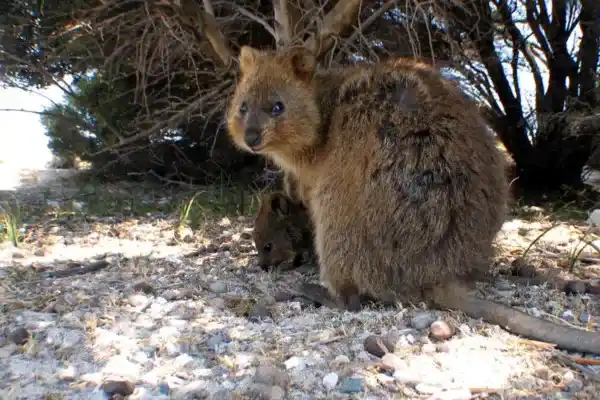
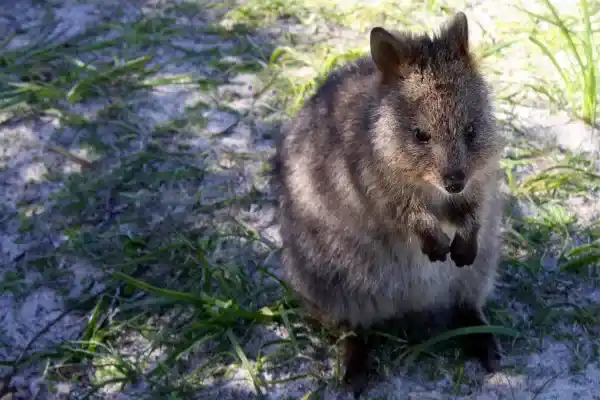
They are about the size of a domestic cat, measuring 40–90 cm in length and weighing 2.5–5 kg . Their limbs and tails are relatively long, strong, and powerful, enabling them to jump and move quickly. Their fur is brownish-gray, with relatively sparse fur on the tail and limbs.
Their size allows them to move nimbly through jungles and bushes, while their cute round faces, short noses, and furry bodies add to their adorable charm.
The personality and "smile" of the world's happiest animal
Quokkas are gentle by nature and not aggressive towards humans . On the contrary, they are very curious and often approach people on their own initiative. They are outgoing, lively, and playful, so they easily leave a friendly impression.
Their most striking feature is their "smiling face." A narrow nose, plump cheeks, and a lively personality make them appear to always be smiling. This unique appearance earned them the title of "World's Happiest Animal" in 2013. Since then, the internet has been filled with photos of them interacting with humans, seemingly spreading joy through their smiles.
Survival threats faced by quokkas
Although quokkas have become popular online, their survival status is far from optimistic. According to the IUCN Red List of Threatened Species , quokkas are currently listed as "Vulnerable" and their population is declining.
The main reasons for this situation include:
Tourism stress : Many tourists feed quokkas unsuitable food in order to take photos, disrupting their natural eating habits and even causing malnutrition.
Illegal capture and trade : Some criminals capture quokkas to keep as "private pets" or sell them to illegal zoos. In reality, they are not suitable for captivity.
Traffic and accidents : Because quokkas approach humans, traffic accidents or accidental injuries are inevitable.
Habitat shrinkage : The expansion of human activities has gradually reduced their living space.
To protect this species, Australia has enacted strict laws prohibiting touching, capturing, or feeding quokkas . Violators may be fined between AU$300 and AU$2,000 . The only exception is when the animal is injured or in danger, in which case people may attempt to rescue it and must immediately contact their local animal protection agency.
Summarize
Quokkas have become social media stars with their unique "smile" and friendliness, but they remain a vulnerable species that needs human protection.
If you have the opportunity to visit Australia to see them, please remember:
Do not feed them human food;
Do not touch or pick them up unnecessarily;
The best way to protect them is to maintain a safe distance and use a camera to capture their natural beauty.
In this way, quokkas can continue to live freely and happily in their home.