Accurate sex determination is a fundamental and crucial skill in rabbit husbandry, breeding, and health management. Compared to pets like cats and dogs, sex determination in rabbits is slightly more complex, especially in the early stages. This article will systematically introduce methods, precautions, and techniques for sex determination at different stages from an anatomical and behavioral perspective.
Why is it necessary to determine the sex of a rabbit?
1.1 Avoid unplanned breeding
Keeping male and female rabbits together may lead to unintended pregnancies, causing overbreeding and even health problems for the pets.
1.2 Improve feeding and management efficiency
Knowing the sex helps with pair breeding, cage management, and behavior control (such as aggression and marking behavior).
1.3 Differences in Disease Prevention and Treatment
Some diseases (such as uterine cancer) are specific to female rabbits, and sex determination is crucial for disease prevention and surgical decisions.
II. The Best Time to Determine Gender
2.1 Young rabbit stage (2-6 weeks after birth)
At this stage, gender characteristics are not yet obvious, making it difficult to determine, but preliminary observation is possible.
2.2 Puberty (6-12 weeks)
The development of sexual organs can be determined using appropriate methods.
2.3 Adulthood (3 months and older)
When sexual characteristics are obvious, it is the period when males and females are easiest to distinguish.
III. Determining sex through external anatomical structures
3.1 Basic Steps
Lay the rabbit on its back or gently lift it so that its belly is facing up.
Gently press the area in front of the urethral opening with two fingers to expose the reproductive organs.
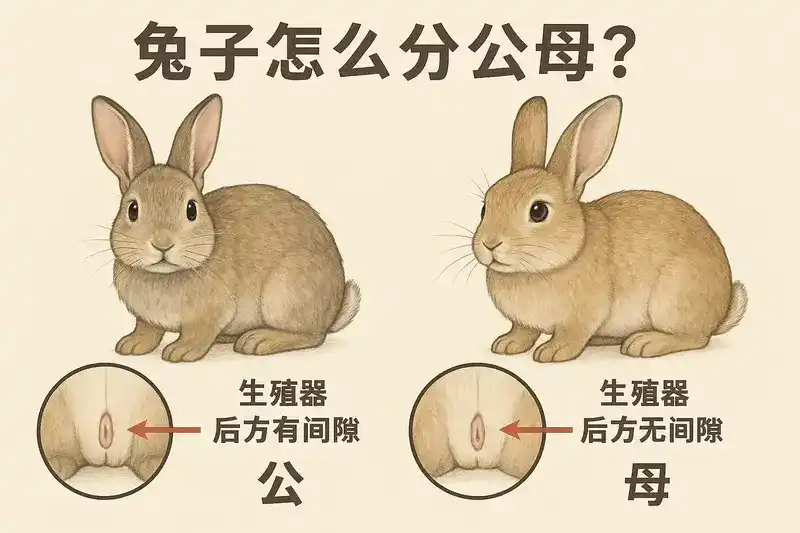
3.2 Characteristics of male rabbits
A clearly visible, cylindrical structure (penis) is present.
The urethral opening is a round hole.
Adult male rabbits have distinct testes (located on either side of the tail base, covered by fur).
3.3 Characteristics of female rabbits
The genitals have a "V"-shaped slit or a thin, elongated protrusion.
The urethral opening is narrower in male rabbits than in female rabbits.
No testicular structure
IV. Other auxiliary methods for distinguishing male and female
4.1 Behavioral Observation
Male rabbits are more likely to exhibit territorial marking and spraying behaviors.
During their mating season, male rabbits will exhibit mounting behavior.
Female rabbits exhibit maternal behaviors such as nest building and plucking fur.
4.2 Gonadal examination (veterinary professional procedure)
The presence of the testes or uterus can be determined by ultrasound or palpation.
4.3 Genetic testing
Some professional breeding farms use DNA testing methods for precise sex determination.
V. Common Causes of Misjudgment and Techniques for Avoiding It
5.1 Young rabbits whose penises are not fully erect are easily confused with their mothers.
To avoid judging solely by appearance, gently press the urogenital opening to observe the genitals.
5.2 Testicular cryptorchidism leads to misdiagnosis
Some male rabbits exhibit undescended testes, which can be addressed with the help of specialized tools or by waiting for them to mature.
5.3 Improper operation leading to stress
Improper force may frighten the rabbit, so the movements should be gentle and the environment quiet.
VI. Professional Advice and Conclusion
If you are unsure of a rabbit's sex, it is recommended to seek help from an experienced breeder or veterinarian. Regular sex checks (especially before mixing with other animals) help prevent mismating and behavioral problems.
Although rabbits are small, sex determination is a crucial aspect of scientific rabbit husbandry. By learning the correct methods and through careful observation, we can not only avoid breeding risks caused by misjudgment, but also manage the health and behavior of our pet rabbits more scientifically, leading to a more harmonious relationship between humans and rabbits.