Swallows are small, streamlined birds with long, narrow wingtips. They excel at catching insects in the air and undertaking long-distance migrations. Different genera and species have distinct distinguishing features: some have reddish-brown rumps, some have horizontal bands on their chests, some have white rumps, and some have pale foreheads. This article summarizes 12 common "swallow" species (Spanish "golondrina" refers to the Hirundinidae family), covering their morphological characteristics, distribution and habitat, nest types and behaviors , and provides key points for quick identification .
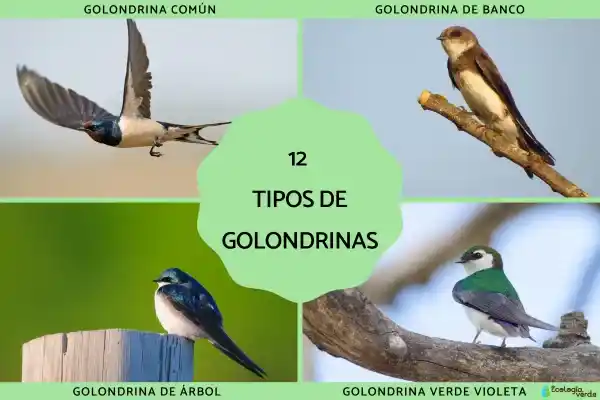
( Hirundinidae | Small, insectivorous migratory bird)
Tip: In Chinese, "swallow" (Hippophae family) and "swift" (Apodidae family) are often confused. Swallows have more developed legs and often land on the ground/tether; swifts have weaker legs, almost never land, have more sickle-shaped wings, and have a sharp call.
Table of contents
How to determine if it is a "swallow" (Quick identification check)
Learn about 12 types of swallows (including key points)
The life cycle of swallows: migration, nest building and feeding
Birdwatching and Conservation: The Impact of Human Activities on Swallows
Frequently Asked Questions (FAQ)
1) How to determine if it is a "swallow" (Quick identification check)
Size and shape : Small (about 12–15 cm), with long and narrow wingtips, and a deep forked tail (but some have a nearly square tail or a shallow forked tail).
Mouth/beak and feeding : The mouth is small but the gape is large, making it adept at catching flying insects (mosquitoes, midges, gnats, flying ants, etc.) in the air .
Flight mode : agile maneuvering, variable speed turning; often flies low to the ground/water to snatch food.
Nest type : They mostly build half-bowl or pot-shaped nests using mud and grass stems ; some dig burrows in sandy walls/riverbanks to breed in groups.
Differences from swifts : Swallows can perch on lines/branches and have more developed toes; swifts often cling to walls and rarely touch the ground.
2) Learn about 12 species of swallows one by one
Note: The following Chinese names are common translations/interpretive translations, and the scientific names are in parentheses; for easy retrieval, the original Spanish species names and distribution overviews have been retained.
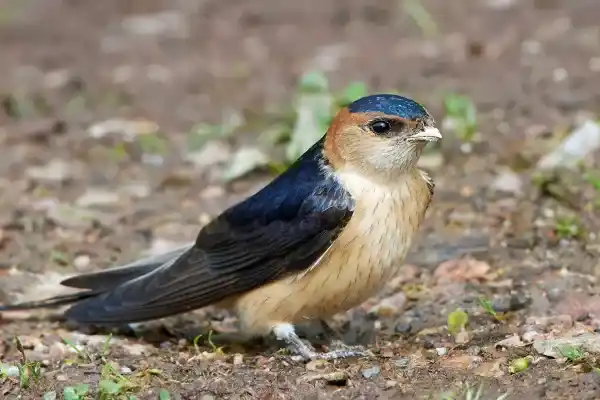
1) Daurian golden-waisted swallow ( Cecropis daurica )
Distribution : Eurasia and Africa; breeds in Europe/Asia, winters in Africa and India. A common species in Spain besides the barn swallow.
Habitat : Warm Mediterranean scrubland , valleys, cliffs and rural buildings.
Key features of the form :
The back has a dark blue sheen ; the waist and hips are strikingly reddish-brown ("golden waist"); the abdomen is light ochre with spots; and the tail is deeply forked .
When flying, its reddish-brown rump is easily visible in sunlight, which is a key difference between it and a barn swallow.
Diet : It catches small flying insects such as mosquitoes and flies in the air.
Nest type : It is usually a pot-shaped closed nest with a short trumpet-shaped entrance, attached to rock walls/eaves.
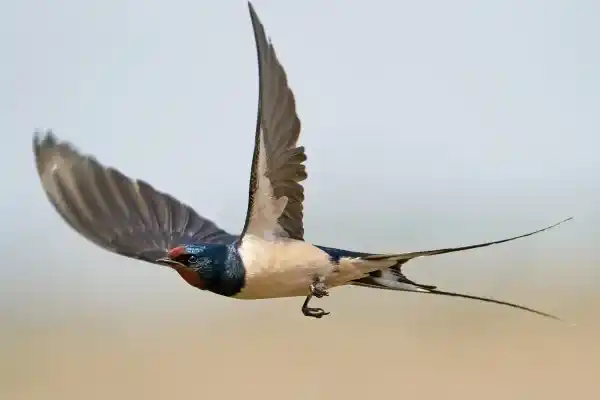
2) Barn swallow/Common swallow ( Hirundo rustica )
Distribution : Breeds in the Northern Hemisphere (including European countries such as Spain), and overwinters in a wide area of the Southern Hemisphere.
Habitat : grasslands, fields, courtyards, and above water; prefers to nest in artificial structures (barns, bridges).
Key features of the form :
The back is cobalt blue with a metallic sheen ; the forehead and throat are deep chestnut red ; the belly is pale ochre/creamy yellow ; the tail is extremely forked , with white spots visible at the tips of the outer tail feathers during flight.
Diet : Preys on flying insects at low altitudes.
Nest type : Half-bowl shaped mud nest, mostly attached to the inner wall of beams/bridge openings.
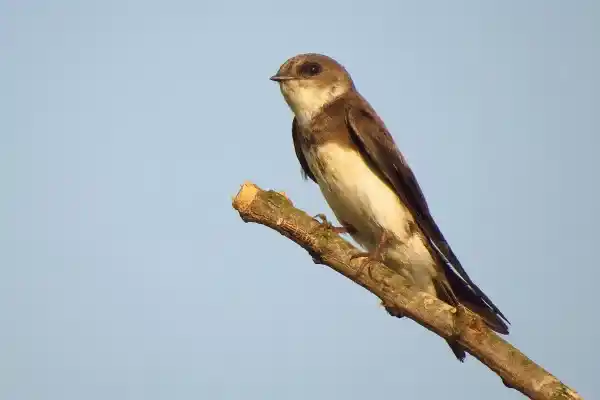
3) Sand Martin/Shore Martin ( Riparia riparia )
Distribution : Widely found in Eurasia, North America, and Africa; winters in South America and the Sahel region.
Habitat : riverbanks/sand walls/quarries ; groups burrow and nest , forming high-density communities.
Key features of the form :
It is about 12 cm long; its back is brown, its belly is white, and there is a brown horizontal stripe on its chest ; its tail is short and shallowly forked .
Diet : It preys on small flying insects near water.
Nest type : The nest is made of sand with tunnels that can be tens of centimeters long.
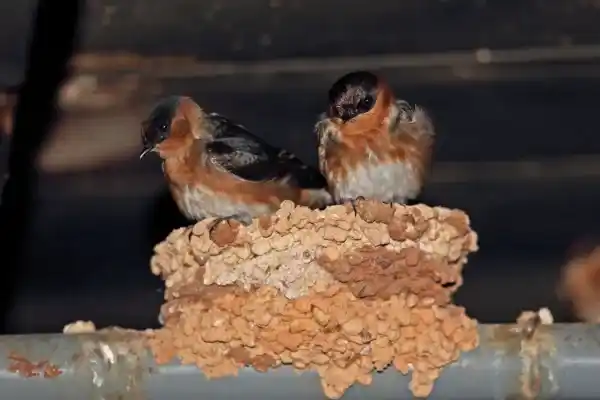
4) Cave swallow ( Petrochelidon fulva )
Distribution : Southern North America, Mexico, and the Caribbean; some are settled , while others migrate .
Habitat : caves, sinkholes, bridges and buildings ; forages in open areas near water.
Key features of the form :
Back bluish-grey ; waist and forehead brownish ; throat light brown ; tail nearly square ( distinct from most swallows with deep forked tails ).
Diet : They fly in groups to prey on flying insects.
Nest type : It often lives in the same gregarious environment as the sand martins, but its nest is a mud pot-shaped nest attached to the wall.
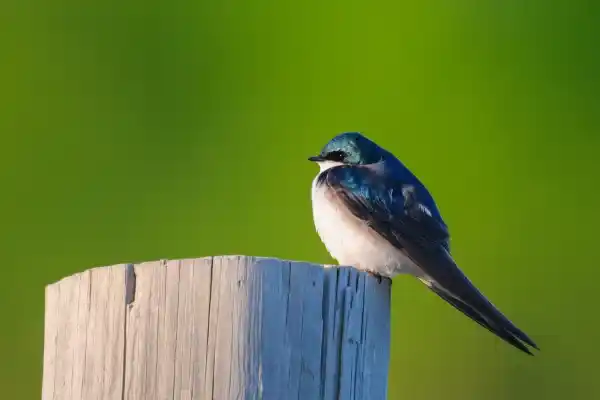
5) Tree swallow ( Tachycineta bicolor )
Distribution : Breeds in North America; winters in Mexico, Central America, and the Caribbean.
Habitat : Open fields, wetlands, lake shores; make good use of natural tree cavities or artificial nest boxes .
Key features of the form :
Its back has a bluish-green metallic sheen, its belly is pure white , and its tail is shallowly forked , giving it a clean and strong overall contrast.
Diet : Primarily feeds on flying insects, and occasionally on fruits .
Nest type : cave nest type; it enjoys occupying nest boxes and is a star species in North America for promoting nest box conservation .
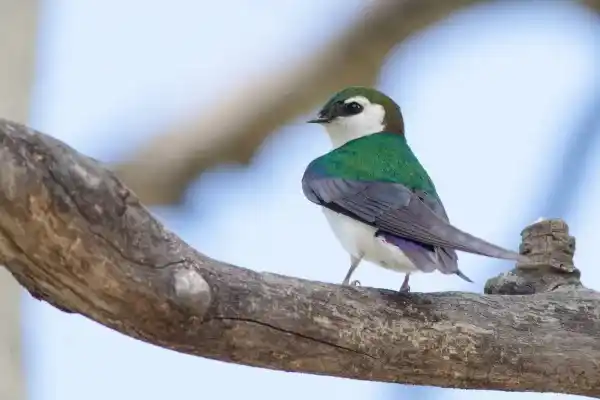
6) Green Purple Swallow / Green Purple Tree Swallow ( Tachycineta thalassina )
Distribution : Western North America, Canada, Alaska to Mexico; winters in Central America.
Habitat : grasslands, riverbanks, lakes, and woodland caves.
Key features of the form :
It is about 13 cm in length; its back is metallic green, its rump/waist is purplish iridescent , its belly is white, and its tail is forked ; the white underwings extending to the sides of its waist are key identifying features.
Diet : It preys on beetles, ants, wasps, moths, and other insects from the air.
Nest type : tree hole/nest box.
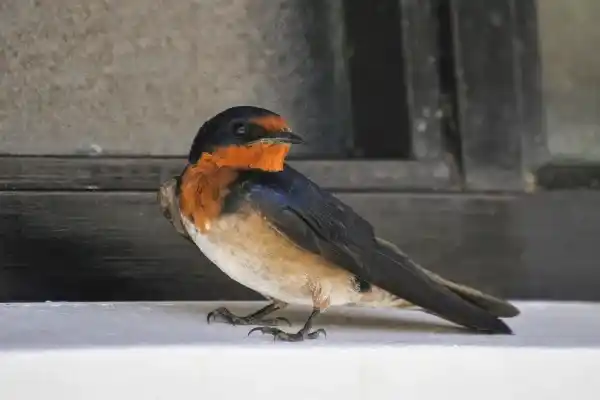
7) Petrochelidon pyrrhonota
Distribution : Breeds from Alaska and Canada to Mexico, overwinters in South America.
Habitat : Open areas, cliffs , lakes and marshes.
Key features of the form :
Body length 14–15 cm ; pale white forehead ; glossy blue-black back ; reddish-brown throat ; orange-rusty rump ; white belly ; relatively short tail.
Compared to cave swallows, it has a lighter forehead, a more orange-rusty waist , and a wider distribution range.
Food habits : Flying in groups to catch insects.
Nest type : Mud pot nest , often nested in large colonies on bridges/rock shelves.
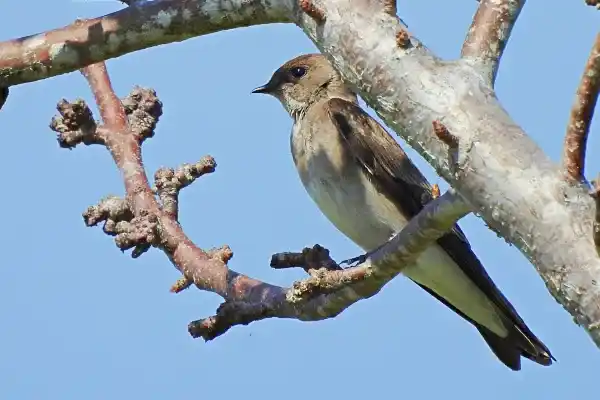
8) Northern Rough-winged Swallow ( Stelgidopteryx serripennis )
Distribution : Breeds in North America; winters in Mexico, Central America, and the Caribbean.
Habitat : woodlands, wetlands, waterways, and rocky banks.
Key features of the form :
Body length 13–15 cm ; back brown, belly white, throat darker ; tail shallowly forked ; male primary flight feathers have “serrated hard feathers” on the outer edge (hence the name).
Similar to the sand martin, but without the complete brown horizontal band on its chest .
Diet : Flies low to the water to catch insects.
Nest type : cavities or natural crevices.
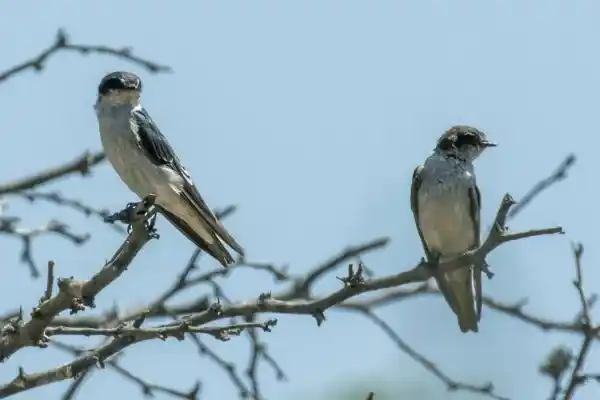
9) Tachycineta stolzmanni (Tombearn Swallow)
Distribution : Coastal areas of northwestern Peru (from La Livetad) and southwestern Ecuador (Roja Province).
Habitat : Open area near water.
Key features of the form :
It is about 13.5 cm long; its back is bluish-green and glossy, its waist is white ; its belly is white with fine black stripes ; and its tail is nearly square .
Diet : Preys on flying insects at low altitudes.
Nest type : caves/building crevices, etc.
10) Andean swallow ( Orochelidon andecola )
Distribution : Andes Mountains (southern Peru, western Bolivia, northern Chile, northwestern Argentina); elevation 2,500–4,600 m .
Habitat : Valleys, steep slopes and alpine meadows (puna) , often found near streams and hillsides.
Key features of the form :
It is 14 cm long; its back is dark blue, its waist is gray, and its belly is nearly white ; it flies steadily in high-altitude and strong-wind environments.
Diet : Catches insects in open areas.
Nest type : rock crevice/earth cave.
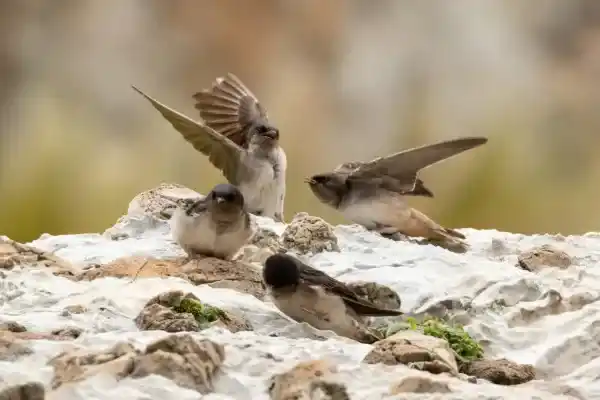
11) Brown-bellied Swallow ( Orochelidon murina )
Distribution : Andes Mountains of Colombia, Ecuador, Peru, and Bolivia; altitude 2,200–4,300 m .
Habitat : dwarf forests, kewiña thickets, alpine meadows, farmland and small settlements.
Key features of the form :
It is 13.5 cm long; its back is blue, its throat is white, its belly is grayish-brown , and its tail is forked ; it often flies low among the canopy and shrubs .
Food habits : Catching insects at low altitudes on forest edges.
Nest type : rock crevice/cave.

12) Brown-headed Swallow ( Alopochelidon fucata )
Distribution : From southeastern Peru and Bolivia, through Brazil and Uruguay to northern Argentina.
Habitat : grasslands, savannas, wetlands, and lowland open areas .
Key features of the form :
Body length 12 cm ; back grayish-brown, head and chest "lion-colored/brownish-ochre" , belly white, tail nearly square .
Diet : It hunts insects in the air above fields and swamps.
Nest type : natural cavities/man-made structures.
3) The life cycle of swallows: migration, nest building and feeding
Migration : Mostly long-distance migratory birds , breeding in the Northern Hemisphere during spring and summer and migrating south during autumn and winter . Intercontinental travel depends on good resting places and the supply of aerial insects .
Nest building : They often use mud balls and fibers/grass stems to build half-bowl or pot-shaped nests, or they burrow into sand walls to reproduce in groups.
Brood rearing : Parent birds catch insects in the air and feed them by forming them into balls ; after the chicks leave the nest, they will still follow their parents for a short period of time to learn how to forage.
Coloniality : Many species roost in reed beds/forests in the thousands during the off-season, creating spectacular "swallow tides".
4) Birdwatching and Conservation: The Impact of Human Activities on Swallows
Pesticides and urbanization have led to a decrease in aerial insects , causing a shortage of food sources for swallows;
Sealed urban facades , smooth materials, and clean management reduce mud and adhesion sites , affecting nesting;
The traffic accident resulted in a fatal collision with the glass window .
Bridges/eaves are used to clear nests and disrupt breeding.
Friendly approach :
Retain or add nest sites (using biomimetic nest trays/nest boards, provided compliance is in place).
Provide clean mud sources nearby, but fail to clean key eaves corners after rain;
Reduce the use of highly toxic broad-spectrum pesticides and promote ecological agriculture/integrated pest management (IPM) ;
When birdwatching and photography, maintain a distance and avoid repeatedly using close-up lighting during the nesting season.
5) Frequently Asked Questions (FAQ)
Q1: How can you tell the difference between a swallow and a swift?
Swallows (Hippophae family) can perch on lines/branches , have deeply forked tails, small beaks, and large mouths; swifts (Apodidae family) have sickle-shaped wings , weak legs that rarely touch the ground, and fly much faster with sharp whistling.
Q2: How to quickly distinguish between barn swallows and golden swiftlets?
Barn swallows have a deep chestnut-red throat and forehead, and a very deep forked tail ; the Daurian golden-rumped swallow has very conspicuous reddish-brown patches on its waist/hips , and often builds pot-shaped enclosed nests .
Q3: The Sand Martin and the Northern Roughwinged Martin look very similar. How can you tell them apart?
Examine the brown horizontal band on the chest : the Sand Martin has a distinct chest band ; the Northern Roughwinged Martin has no complete chest band , and the male has rough, serrated feathers on the wing edges.
Q4: How to distinguish between cliff swallows and cave swallows?
The cliff swallow's forehead is paler and its waist is more orange-rusty ; the cave swallow's tail is nearly square and its overall blue-gray back makes it appear more stable.
Conclusion
Swallows are not only adorable, but also regulators of airborne insect populations and ecological indicator species . Recognizing the subtle differences among various golondrina species and preserving habitats and food sources for them is essential for sustaining the ecological networks of cities and the countryside.
bibliography
SEO Bird Life. Available at: https://seo.org
Everything about birds. Available at: https://www.allaboutbirds.org
Aves, Peru. Accessible via: https://avesdeperu.org