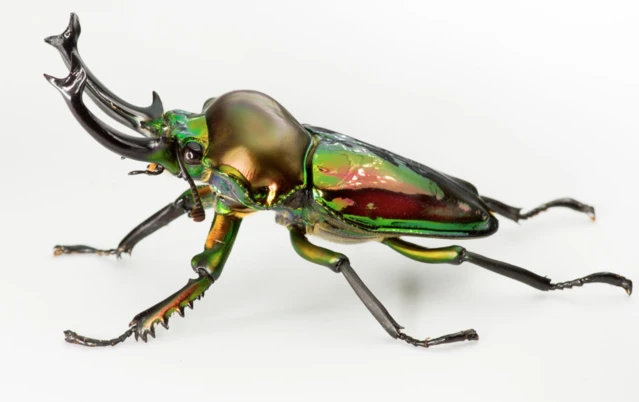
The Rainbow Stag Beetle (Phalacrognathus muelleri), also known as Mueller's Stag Beetle, Rainbow Staghorn Beetle, King Staghorn Beetle, or Magnificent Staghorn Beetle, is a highly prized ornamental stag beetle. Its vibrant metallic colors make it one of the most iconic stag beetles in the world. Belonging to the family Lucanidae, it is primarily distributed in the tropical forests of northern Australia (Queensland), New Guinea, and surrounding areas. Due to its striking appearance and unique morphology, it has been chosen as the official symbol of the Entomological Society of Queensland and is highly sought after by insect enthusiasts and collectors.
Taxonomy
Animal Kingdom
Phylum Arthropoda
Hexapoda
Insecta
Pterygota
Coleoptera
Polyphaga
Scarabaeiformia (inferior order)
Scarabaeoidea
Lucanidae (stag beetle family)
Lampriminae
genus Phalacrognathus
Rainbow scorpion Phalacrognathus muelleri
Morphological characteristics
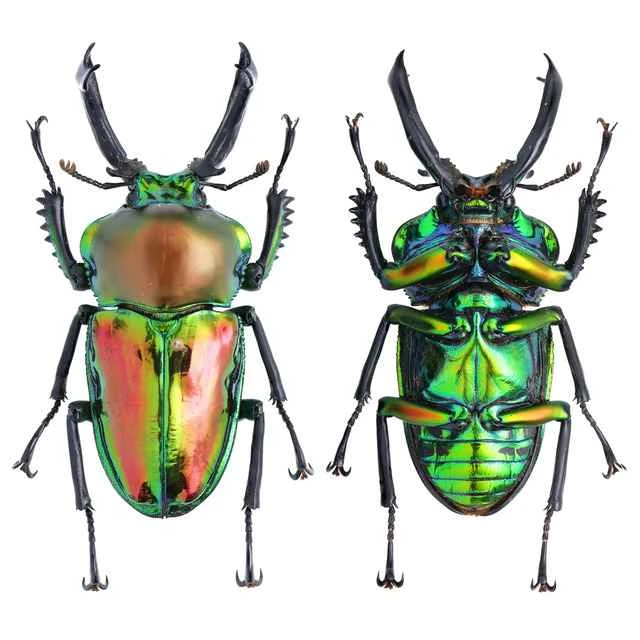
The most distinctive feature of the rainbow stag beetle is its metallic exoskeleton, which can display different shades of green, red, blue, black, purple, or copper, refracting light to create a dazzling rainbow effect. This color is not caused by pigments, but rather by structural color (the interference of light by the microscopic surface structure).
Sexual dimorphism (sexual variation)
Male: Male rainbow stag beetles are relatively large, reaching up to 70 mm in length, and possess large, curved, sickle-shaped mandibles used to compete for territory and mates. Their powerful mandibles can grip opponents and lift them off branches, demonstrating extremely strong aggression.
Female: The female is smaller, about 30-40 mm in size, without well-developed mandibles, and has a more rounded overall shape. Her forelegs are more robust, which is adapted to digging bark and finding places to lay eggs.
Ecology and Habits
Habitat
Rainbow stag beetles mainly live in tropical rainforests, where they typically inhabit decaying tree trunks, dead wood, and leaf litter. These places not only provide a food source but also an ideal environment for the development of larvae.
feeding habits
Adults: They mainly feed on tree sap, rotten fruit, and nectar, and prefer sweet sap.
Larvae: They mainly feed on rotten wood and decaying tree trunks, and wood rich in organic matter is particularly important for their growth.
Reproduction and life cycle
Mating: In order to compete for females, male insects will use their mandibles to fight with rivals, and only the winner is qualified to mate with the female.
Laying eggs: Females will dig holes in rotten wood to lay their eggs, sometimes laying dozens of eggs at a time. They usually choose moist, nutrient-rich dead wood.
Larval stage: The larval development period is relatively long, usually 6-12 months. Its body length can reach more than 80 mm. Its body color is milky white, its head is brown, and its body shape is plump.
Pupal stage: After the larvae mature, they will build a pupal chamber in the decaying wood and enter the pupation stage, which lasts for about 1-2 months.
Adult lifespan: After emerging from the molt, adults can live for 8-12 months, but wild individuals may have a shorter lifespan due to environmental factors.
Artificial breeding and collection value
Rainbow stag beetles have become a popular breed among insect enthusiasts in recent years due to their vibrant colors and ease of captivity. The colors of artificially bred individuals can be optimized through genetic screening and environmental control to produce even more vivid hues.
Feeding tips
Environment: The ideal temperature is 24-28°C, the humidity is maintained at 70-80%, and sufficient decaying wood and sap are provided.
Food: You can feed them high-sugar foods such as bananas, apples, honey water, and special insect jelly.
Reproduction: Providing nutrient-rich decaying wood helps females lay eggs successfully and prevents larvae from dying due to unsuitable environment.
Ecological value and current state of protection
Rainbow stag beetles play a vital role in the ecosystem, helping to decompose decaying wood, promoting forest ecological cycles, and serving as an important food source for other predatory insects and birds. Although not currently listed as endangered, wild populations are facing pressure due to habitat destruction, illegal fishing, and climate change. Entomologists are calling for strengthened forest protection and restrictions on commercial fishing to maintain the stability of their populations.
Cultural significance and the collectibles market
Due to its unique colors, the rainbow stag beetle is highly valued in insect collecting markets worldwide, with some rarer colored individuals (such as pure blue or purple) fetching hundreds of dollars at auction. Furthermore, it is the official emblem of the Entomological Society of Queensland, Australia, symbolizing the biodiversity of the rainforest.
Summarize
The rainbow stag beetle (Phalacrognathus muelleri) is a brightly colored stag beetle, renowned for its metallic exoskeleton, large, sickle-shaped mandibles, and unique sexual dimorphism. They inhabit tropical rainforests, feeding on tree sap and decaying fruit, and their life cycle consists of three main stages: larva, pupa, and adult. Although this species is not currently listed as endangered, habitat destruction and overhunting may impact its wild population. A prized possession for insect enthusiasts, the rainbow stag beetle is one of the most popular stag beetles worldwide due to its stunning appearance and relatively simple care.