Dinosaur fish (scientific name: Polypteridae ) , also known as multifinned fish, Belonging to the order Polypteriformes, family Polypteridae, and genus Polypterus, they are an ancient type of freshwater fish, hailed as "living fossils," and are beloved by aquarium enthusiasts for their primitive appearance and "living fossil" status. They not only possess crocodile-like hard scales and a slender body, but also have a dual respiratory system , breathing through gills and lungs, enabling them to survive in extreme environments.
They are mainly distributed in rivers, lakes and swamps in Africa, and are named "multifinned fish" because of the neatly arranged small fin-like structures on their backs, which resemble a row of flags.
Dinosaur fish possess hard, diamond-shaped scales, unique fin rays, and a slender body. They are gentle in nature but ferocious when hunting. Due to their strong adaptability, they have become a popular aquaculture species for tropical freshwater fish enthusiasts.
I. A Complete Guide to Dinosaur Fish Varieties
The dinosaur family comprises several species, each differing slightly in size, color, and habits. Below are some of the most common dinosaur species:
Comparison table of dinosaur fish varieties
| Variety Name | scientific name | Maximum body length | Color characteristics | Difficulty of raising | Main distribution | |
|---|---|---|---|---|---|---|
| Senegalese Dinosaur Fish (Grey Dinosaur) | Polypterus senegalus | 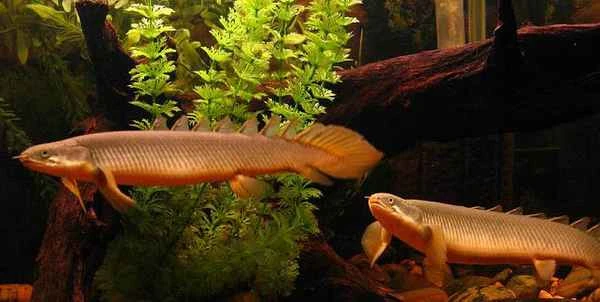 | 30-50cm | Grayish-white or light brown, with a few varieties exhibiting albinism. | easy | West Africa |
| Marble Dinosaur Fish (Flower Dinosaur) | Polypterus ornatipinnis |  | 40-60cm | Black or dark brown base color, covered with gold patterns | medium | Congo Basin, Africa |
| Congo dinosaur fish (Peacock Dinosaur) | Polypterus teugelsi | 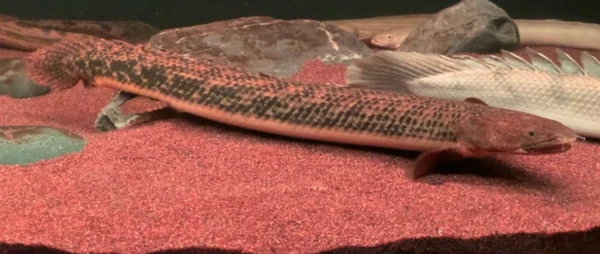 | 40-50cm | Golden or silver-gray markings, slender body | difficulty | Congo River Basin |
| Black dinosaur fish (Bishaldinosaur) | Polypterus bichir bichir | 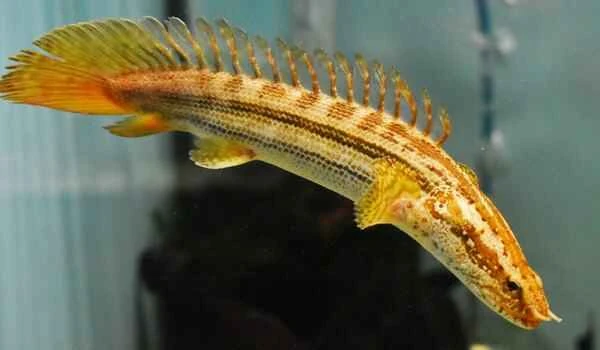 | 50-75cm | Black, gray, or dark brown, large in size | Difficult | Nile River, Lake Chad |
| Engel's dinosaur fish (Tiger Dinosaur) | Polypterus endlicheri |  | 50-80cm | The head is broad and flat, and the body has yellow or orange-red stripes. | Difficult | Niger River, Cameroon |
| Lapradi Dinosaur Fish | Polypterus lapradei |  | 60-75cm | Its body color is pale yellow or silver-gray, and its body shape is slender. | medium | West African Rivers |
| Darwinian Dinosaur Fish | Polypterus delhezi | 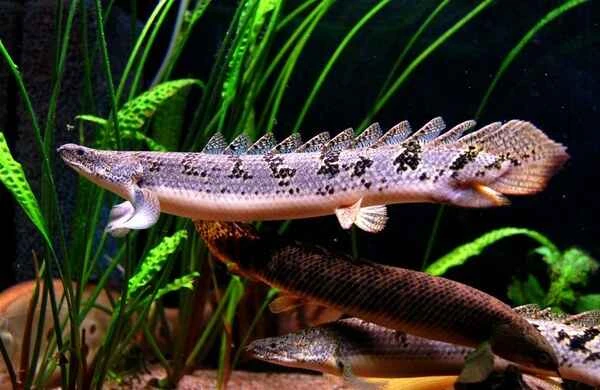 | 40-50cm | Its body is dark green with irregular black stripes. | easy | Congo River Basin |
| Parma Dinosaur Fish | Polypterus palmas | 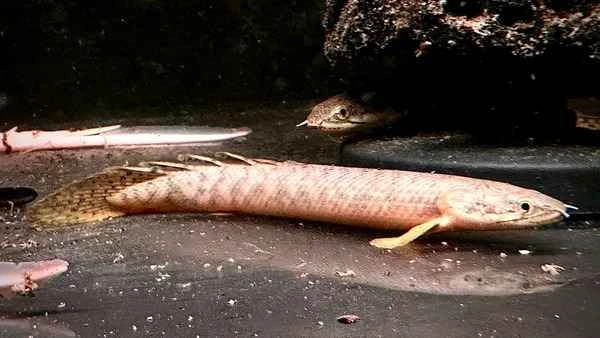 | 35-45cm | Its body is brownish-yellow with black spots. | easy | Coastal areas of West Africa |
II. Morphological characteristics of dinosaur fish
The dinosaur fish has a very unique appearance, possessing characteristics of modern fish while retaining many primitive features of prehistoric fish:
Size : Adult individuals can reach 30-60 cm in length, with some varieties exceeding 70 cm.
Scale structure : The scales are about one five-hundred-millionth of a meter thick and consist of four layers, which can effectively absorb impact and provide strong defense capabilities.
Breathing method : It combines gill respiration and auxiliary lung respiration, enabling it to survive in low-oxygen environments.
Aggressiveness : It is aggressive towards small fish, but can be kept with other large tropical fish.
Highly adaptable : It is not demanding in terms of water quality and can tolerate large temperature differences.
✅ Dual respiratory system : Dinosaur fish can breathe through both gills and lungs, allowing them to survive even in oxygen-deficient environments.
✅Hard scales : Their bodies are covered with hard scales , which can effectively protect them from attacks by predators.
✅Multiple fin structure : The dorsal fin is composed of multiple independent fin rays, giving them flexible swimming ability.
✅Nocturnal habits : Dinosaurs are relatively quiet during the day and more active at night , so it is recommended to feed them at night.
✅ Poor eyesight, but a keen sense of smell : Dinosaur fish mainly rely on their sense of smell to find food , thus they can adapt to relatively murky waters.
III. Living Habits of Dinosaur Fish
1. Diet and foraging strategies of dinosaur fish (polyfinned fish)
The dinosaur fish ( Polypterus spp. ) is a carnivorous, opportunistic predator with a strong nocturnal hunting instinct . They primarily feed on live prey, frozen foods, and high-protein foods . Understanding their natural foraging habits and dietary requirements is crucial for ensuring their health in an aquarium.
1.1. Diet in the wild
In its freshwater habitat in Africa , the dinosaur fish is a benthic ambush predator , whose main diet includes:
Small fish – juveniles, slow-moving fish
Insects and larvae – aquatic insects, beetles, mosquito larvae
Crustaceans – Shrimp, Crab, Crayfish
Worms – Earthworms, bloodworms, black worms
Amphibians - small frogs, tadpoles
Carrion -eating animal – It feeds on carrion, occasionally consuming dead fish or rotting organic matter.
Dinosaur fish rely primarily on their keen sense of smell rather than sight to find food, and they typically forage at night , especially in murky water.
1.1.2. Food suitable for the breeding environment
To keep dinosaur fish healthy and growing quickly , they need a high-protein, nutritionally balanced diet . Here are the recommended food types and feeding frequencies :
| Food types | Example | Recommended feeding frequency | Precautions |
|---|---|---|---|
| live bait | Guppies, glass shrimp, earthworms, mealworms | 2-3 times a week | Stimulate the natural predatory instinct |
| frozen food | Bloodworms, brine shrimp, mysid shrimp, whitebait | 4-5 times per week | Nutrient-rich, avoid a monotonous diet |
| Sinking pellets & Carnivorous fish food | Hikari meat pellets, Massivore Delite, Arowana food | daily | Ensure a balanced diet |
| Raw meat & seafood | Shredded tilapia, shrimp, and squid | 2-3 times a week | Avoid high-fat foods such as beef and chicken. |
| Gel foods | Repashy “Grub Pie”, DIY Seafood Mixed Feed | Occasionally | Provide dietary diversity |
| Live fish fed occasionally | Guppies, mollies, and goldfish (quarantine required) | 1-2 times/month | There is a risk of parasites, and quarantine is required. |
⚠Avoid feeding:
❌ Goldfish & Rose Red Crucian Carp – Contain thiaminase, which may lead to vitamin B1 deficiency. ❌ Processed Human Foods – Contain flavorings, fats, and preservatives, which are harmful to fish. ❌ Overfeeding – May lead to obesity and fatty liver.
1.1.3. Foraging Behavior of Dinosaur Fish
Swallowing prey whole : Dinosaur fish did not have real teeth, but their powerful jaws could firmly grasp and swallow their prey whole .
Nocturnal foraging : They are usually most active at dusk or night , and it is recommended to feed them at this time.
Slow-eating : Unlike some ferocious carnivorous fish, dinosaurs swallow their food rather slowly .
Ambush hunting : Live food (such as small shrimp or small fish) can stimulate their hunting instincts and increase their activity levels.
1.1.4. Feeding Frequency Recommendations
Young fish (under 1 year old) – Feed 2-3 times a day to promote growth.
Sub-adults (1-2 years old) — 1-2 times daily
Adult fish (2 years and older) – once a day or every other day
Tip: Dinosaur fish can tolerate not eating for several days , but maintaining a reasonable feeding frequency in the long term is more beneficial to their health.
1.1.5. Special Dietary Recommendations
✅Promote growth – High-protein foods, such as anchovies, worms, and shrimp. ✅Enhance color – Foods containing astaxanthin (such as krill and shrimp).
✅Extend lifespan – Diversify diet, combining pelleted feed, fresh meat, and appropriate amounts of live food. ✅Stimulate hunting instinct – Occasionally release live glass shrimp or earthworms to enhance their natural foraging behavior.
By providing a diverse diet rich in nutrients , your prehistoric predator will remain healthy, active, and vibrantly colored , accompanying you for many years!
2. Suitable water temperature and water quality
Water temperature : 24-28°C (optimal temperature is 26°C)
Water quality : pH 6.5-7.5 (slightly acidic to neutral)
Water flow : Moderate, avoid excessively strong currents that could affect swimming.
3. Suitable aquarium environment
Cylinder size : at least 80cm or larger; for larger models, 120cm or larger is recommended.
Substrate selection : It is recommended to use soft, fine sand or rounded pebbles to avoid scratching the abdomen.
Filtration system : Uses high-efficiency filtration to maintain stable water quality.
Cover the tank : Dinosaurs are extremely good jumpers, so the tank must be covered to prevent them from jumping out.
IV. Recommendations for keeping dinosaurs with other fish
Dinosaurs are generally gentle, but due to their carnivorous nature , caution should be exercised when keeping them with other fish.
✅Suitable fish for mixed breeding :
Large, gentle fish of similar size, such as oscars, silver arowanas, and parrotfish.
Fish with hard-shelled bodies that are difficult to swallow, such as stingrays and flying phoenixes.
❌Fish species unsuitable for mixed breeding :
Small ornamental fish (such as guppies and tetras) are easily swallowed.
Overly aggressive fish (such as alligator gar) may harm dinosaur fish.
| Mixed-culture type | Recommended fish species | reason |
|---|---|---|
| ✅Suitable for mixed breeding | Large cichlids (such as map cichlids, crown cichlids, and flowerhorn cichlids) | Similar in size, making them less likely to be swallowed. |
| Silver Arowana, Lucky Fish, Discus Fish | Mild-tempered, suitable for large aquariums | |
| Duckbill catfish, Arapaima (silver arowana) | Different living areas reduce conflict | |
| ⚠Caution is advised when keeping them together | Lungfish (Lungfish with blunt snout) | It may bite the dinosaur fish |
| Red-tailed cat, tiger-striped duckbill | Highly aggressive, easily injuring dinosaur fish. | |
| ❌Not suitable for mixed breeding | Small fish (guppies, tetras) | Dinosaur fish will eat them |
| Highly aggressive fish (such as ferocious arowana and large cichlids). | Possibly attacking dinosaur fish |
V. Reproduction Methods of Dinosaur Fish
Dinosaur fish are difficult to breed in captivity , with few successful cases. Breeding methods include:
1. Reproductive Habits
Spawning usually occurs from July to September , with the eggs attaching to aquatic plants to develop.
Parent fish have the habit of protecting their eggs and fry, which increases the survival rate of fry.
2. Reproduction conditions
Prepare a large aquarium with ample hiding space.
Water temperature : 28°C helps stimulate reproduction and increases water flow to stimulate spawning .
Water quality : Slightly acidic (pH 6.5-7.0).
Environment : Set up aquatic plants or driftwood to provide attachment points for spawning.
Artificial incubation of fish eggs prevents parent fish from eating them.
3. Raising juvenile fish
Provide high-protein food , such as live insects, fish, and shrimp, to promote sexual maturity.
They can be fed high-protein foods such as brine shrimp and bloodworms.
Maintaining the water temperature at 26-28°C will improve the survival rate.
VI. Frequently Asked Questions about Dinosaur Fish
1. Do dinosaur fish jump out of their tanks?
✅ Yes! Dinosaur fish are very good jumpers, so it's recommended to cover the aquarium .
2. Is it possible to not install an oxygen pump?
✅ Yes, but it is recommended to maintain good water quality , because although dinosaur fish can breathe with lungs, poor water quality will still affect their health.
3. Can dinosaur fish be kept with small fish?
❌ Not recommended, as small fish are easily eaten by dinosaur fish.
Summarize
The dinosaur is an ancient fish species with high ornamental value, suitable for experienced aquarists. With proper food and water quality, they can thrive. If you appreciate unique aquatic life, why not try keeping a dinosaur?