Every pet owner asks themselves: "Am I raising my dog the right way for his age?"
This article systematically explains the diet, exercise, training, and medical care needed for each stage of a dog's life, from puppies and young dogs to adult dogs, senior dogs, and elderly dogs. It helps you adjust your care methods according to age, rather than adopting a "one-size-fits-all" approach for life.
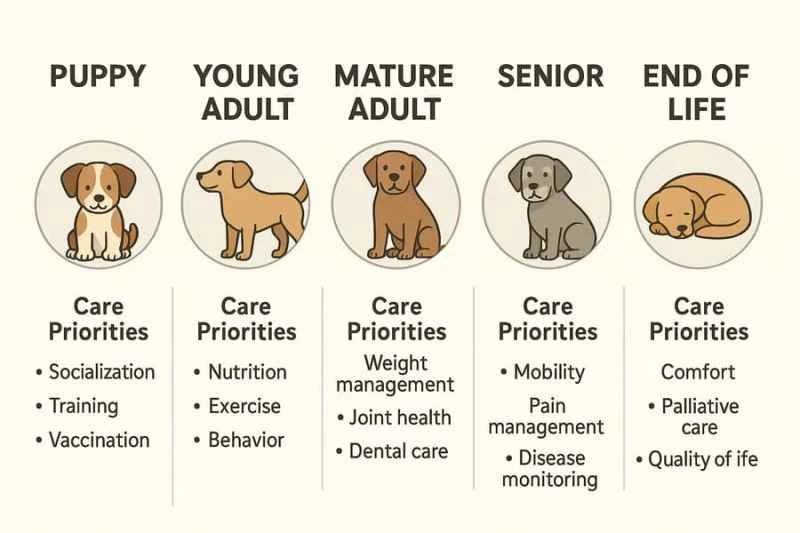
Modern veterinarians generally divide a dog's life into several "life stages," each with different physical changes and disease risks, and corresponding different care priorities. Knowing which stage your dog is currently in makes it easier to "detect and intervene early," allowing it to live longer and more comfortably.
A friendly reminder: The age ranges listed below are for general reference only. Breed, size, genetics, and medical history can all affect the rate of aging, and the final determination should be based on the advice of your veterinarian .
1. How are the life stages of a dog divided?
Most veterinarians and professional organizations divide a dog's life into roughly 5 stages:
Puppyhood : From birth to the end of the rapid growth period (approximately 6–18 months, depending on size).
Young Adult: The period from when growth stops until full maturity (approximately 3–4 years old).
Mature Adult : The middle-aged stage, up to the last 25% of a dog's life expectancy.
Senior : The last 25% of life expectancy (many medium to large breed dogs are considered senior around 7-8 years old).
Geriatric stage : a stage characterized by significant physical weakness, chronic diseases, and functional decline.
Because body shape has a significant impact on lifespan:
Small dog breeds (Chihuahuas, Pomeranians, etc.) tend to age more slowly;
Large and giant breeds (Labradors, Golden Retrievers, German Shepherds, Dobermans, Mastiffs, etc.) age faster.
Age reference table roughly divided by body type
| Life stages | Small dogs (≤10kg) | Medium-sized dog (10–25kg) | Large dogs (25–40kg) | Giant dogs (≥40kg) |
|---|---|---|---|---|
| Puppy | 0–9 months | 0–12 months | 0–15 months | 0–18–24 months |
| Young Adult | 9–24 months | 1–3 years old | 1.5–3 years old | 2–3 years old |
| Mature Adult Dog | 2–8 years old | 3–7 years old | 3–6 years old | 3–5 years old |
| Senior | 8–11+ years old | 7–10+ years old | 6–9+ years old | 5–8+ years old |
| Geriatric/EOL | 11+ years old | 10+ years old | 9+ years old | 7–8+ years old |
This chart can serve as a general reference for your judgment, but the most important thing is to observe the dog's actual condition and consult a veterinarian .
II. Puppy Years: Laying a Solid Foundation for Lifelong Health
Approximate age: Birth to 6–18 months (depending on size)
Puppyhood is the most rapidly changing and crucial stage. In just a few weeks, a puppy can transform from a tiny, barely-open-eyed creature into a mischievous little devil, running around and wanting to bite everything. How well you handle this stage will affect its health and personality for the rest of its life.
Important milestones for puppies
Newborn period (0–2 weeks) : Almost all behaviors depend on the mother dog, mainly nursing and keeping warm.
Transition period (2–4 weeks) : Start to open your eyes, hear sounds, and slowly try to stand and walk.
Critical socialization period (3–16 weeks) : The brain is highly plastic and this is the golden period for contact with people, peers, environment and various sounds.
Tooth replacement period (3–6 months) : Baby teeth fall out and permanent teeth grow in, and the urge to bite is very strong.
Puppy Care Tips
1. Nutritional feeding
You must choose a complete and balanced puppy food , especially for large and medium-sized dogs that will weigh more than 25kg in the future, you should choose a large breed/large breed puppy formula .
For the first few months after arriving home, it is generally recommended to feed them 3-4 small meals a day . As they grow older, this can be adjusted to 2-3 meals a day.
Do not make unbalanced homemade dog food, and do not blindly feed them raw meat, bones, etc.
2. Vaccines and Deworming
Complete the basic immunizations according to the schedule set by the veterinarian (usually every 2–4 weeks, continuing until around 16 weeks).
Timely internal and external deworming (fleas, ticks, heartworms, intestinal nematodes, etc.).
Discuss the timing of sterilization with the veterinarian, and whether a microchip should be implanted.
3. Training and Socialization
As soon as you get home, you should start toilet training and basic commands (sit down, come here, don't wait).
Socialization training should be conducted in a planned manner: expose individuals to people of different ages and genders, and expose them to various surfaces, environments, and sounds; the premise is that it is safe, controllable, and avoids excessive stimulation at one time.
Use rewards as the primary training tool and avoid harsh punishments , otherwise you may raise a timid, nervous, or even aggressive dog.
4. Environment and Safety
"Puppy-proof" home in advance: Keep electrical cords, poisonous plants, small items, and items that pose a risk of being swallowed out of reach of puppies.
Prepare some safe teething toys to help your baby get through the teething period.
Give your puppy a quiet and safe sleeping space so it can learn to rest independently.
The goal of the puppy stage is to help the dog get used to the human world, establish a good health foundation and a trusting relationship, so that it will be easier for it to become a stable, friendly and adaptable adult dog in the future.
III. Adolescence: A crucial stage of high energy and habit formation
Approximate age: From the end of growth to about 3–4 years old
When a dog's bones have mostly stopped growing and its size has stabilized, it enters its adolescence (Young Adult) . Dogs at this stage are typically at their physical peak: strong, energetic, and often seem to have "never had enough playtime." However, behaviorally, they may still act like a "rebellious teenager," occasionally testing your limits.
Common behaviors in young dogs
Strong physique, high endurance, and well-defined muscles
Enjoys playing and is full of curiosity about the outside world.
Sometimes it exhibits "selective deafness," meaning it may not respond immediately when called.
Preferences for dog friends and human friends gradually become fixed.
Key points of nursing care during adolescence
1. Exercise and weight management
Depending on breed and energy level, ensure adequate daily exercise : many dogs need at least 60 minutes, while working dogs and herding dogs may need more.
Exercise can take the form of walking, ball games, tug-of-war, chasing games, etc., and safe cordless activities can be arranged if conditions permit.
Regularly check your dog's ribs and waistline, and learn about Body Condition Score (BCS) with your veterinarian to prevent them from becoming "chubby dogs" at a young age.
2. Brain and behavioral strain
Multiple short training sessions (5–10 minutes) throughout the day are more effective than one long training session.
Use smelling games, food hunts, smelling mats, and brain-training toys to help it expend energy while engaging its brain.
Rotate your dog's toys regularly to prevent them from becoming uninteresting.
3. Healthcare
Have a health check-up at least once a year : physical examination, booster vaccinations, and parasite prevention.
If you experience itchy skin, lameness, indigestion, or significant changes in behavior, seek medical attention promptly instead of waiting until the condition worsens.
4. Rules and Boundaries
Reinforce polite behavior: do not lunge under the leash, do not pounce on people, and rest quietly at home.
If problems such as snatching food, possessiveness of belongings, aggression towards other dogs or people, or separation anxiety occur, it is best to seek help from a professional trainer or behavioral veterinarian as soon as possible, so that these problems do not become "habits" .
The goal of youth: to channel abundant energy into the "right things," solidify good habits, and save a lot of trouble for the rest of your life.
IV. Mature Adult Stage: Maintaining stability in middle age and preventing problems in old age.
Approximate age: from full maturity to the last 25% of life expectancy.
Many dogs are most stable during their Mature Adult stage : their physical condition remains good, their behavioral habits are largely established, and they are very familiar with household rules. However, physiologically, some subtle "slow changes" may begin to appear at this stage, especially in large breeds.

Subtle changes that need to be noticed
My athletic endurance has declined slightly; I can't run as wildly as I used to when I was younger.
I ate the same things as before, but I quietly gained weight.
Bad breath, noticeable plaque, and red gums—periodontal disease is on its way.
Occasionally, I feel a slight limp after exercise and have difficulty getting up.
Care Focus of Mature Adult Dogs
1. Preventive physical examinations
As advised by your veterinarian, have an annual (or semi-annual) check-up , including a physical examination, blood tests, urine tests, and imaging examinations if necessary.
Adjust vaccination and deworming schedules according to actual lifestyle (e.g., more frequent outings and contact with other dogs may require more stringent preventative measures).
2. Diet and Weight Management
As their metabolism slows down, many dogs need to reduce their daily calorie intake to maintain their ideal weight.
Discuss with your veterinarian whether you need joint health supplements (such as fish oil, glucosamine, etc.).
Insist on weighing grains according to the prescribed amount , do not allow free feeding, and certainly do not allow the animal to eat whatever humans eat.
3. Regular exercise and mental health
Continue to exercise daily to prevent muscle loss and obesity, but you can appropriately reduce the intensity.
Maintaining regular training and interactive games can prevent dogs from becoming "bored and depressed" in middle age and also help delay future cognitive decline.
4. Oral care
Brush your dog's teeth regularly (at least 3 times a week), or use a veterinarian-approved chewable oral care product.
Schedule a teeth cleaning as needed to prevent severe periodontal disease from triggering systemic diseases such as heart and kidney problems.
The goals of a mature adult dog are to maintain ideal weight, teeth, joint and organ function, and nip potential "major problems" in the bud as early as possible.
V. Old Age: Helping the aging body and brain "slow down without suffering"
Approximate age: Most medium-sized dogs enter their senior years between 7 and 10 years old, large dogs earlier, and small dogs later.
When a dog reaches about 75% of its life expectancy, it can generally be considered a senior dog . You'll see more white fur and a slower pace, but with proper care, many senior dogs can still happily go for walks, play, and be affectionate.
Common characteristics of older dogs
The area around the mouth, nose, and eyes turned noticeably whiter.
Getting up and walking become slower, and going downstairs becomes difficult.
I prefer sleeping and don't like to go crazy.
Hearing loss, slower response to being called by name
Increased frequency of urination, and even occasional incontinence.
Changes in sleep rhythm, being awake at night and sleepy during the day.
Key points of care for senior dogs
1. More frequent physical examinations
It is recommended to have a comprehensive physical examination every 6 months , including blood and urine tests, and if possible, specialized examinations for the heart, kidneys, etc.
Key screening areas include: arthritis, heart disease, kidney disease, tumors, and Alzheimer's disease.
2. Special diet for senior dogs
You can switch to senior dog food as advised by your veterinarian: the protein, fat and calorie composition will usually be adjusted, while adding nutrients that support joints, heart and immune system.
Control the amount of food more carefully, and try to keep the older dog in a lean rather than fat body shape to reduce the burden on the joints.
3. Gentle and regular exercise
Try to avoid high-intensity, high-impact sports (long-distance running, jumping from heights, etc.), and instead engage in multiple short walks or gentle games .
If your dog enjoys water and is physically able, you can consider low-impact activities such as swimming.
4. Environment and Comfort
Provide a soft, supportive dog bed , preferably in a warm, quiet location that is easy to access.
Lay non-slip mats on smooth floors to reduce the risk of falling.
Use ramps or steps to help it get into the car or bed, instead of having it jump.
5. Cognitive and Emotional Support
Keep your brain active by consistently engaging in simple training and smelling games.
Be more patient with "mistakes" caused by aging (such as making a mess at home or shouting at night). Many of these are due to illness or cognitive issues, not "deliberate mischief".
Maintain a stable lifestyle and family members, and minimize drastic changes in the environment.
The goals for senior years are to slow down functional decline, reduce pain and discomfort, and ensure that dogs still feel safe, comfortable, and loved in their later years.
VI. Advanced Age and Terminal Stage: Quality-of-Life-Focused Care
Approximate age: Small dogs may be 11–15 years or older, while large dogs may be 9–10 years or even younger.
As dogs enter their advanced/terminal stages , the reserves in their various systems decline significantly, and many chronic diseases become more severe. At this point, the focus of care shifts from "extending life" to "prioritizing quality of life."
Common signs in senior dogs
Going up and down stairs and getting up are very difficult; one needs help.
Significant muscle loss may be accompanied by either emaciation or abnormal obesity.
worsening of chronic diseases such as arthritis, heart and kidney disease
Decreased bowel control, often unable to reach a fixed location in time.
Cognitive impairment symptoms include wandering at night, staring blankly, and not recognizing familiar people or environments.
How to care for an elderly dog
Work with a veterinarian to develop a pain management plan , including painkillers, anti-inflammatory drugs, nutritional supplements, and physical therapy.
Create an "accessible environment" at home: food and water bowls at the right height, ramps, non-slip floors, and easily accessible rest areas.
Help it do things it can do by itself, such as grooming, washing its feet, wiping its body, trimming its paw hair and nails.
Regularly assess your quality of life : appetite, pain control, ability to move independently, and ability to derive pleasure from daily life.
When pain outweighs pleasure, have a serious discussion with your family and veterinarian about end-of-life care and euthanasia, and say goodbye in the gentlest way.
The goals for senior dogs are to reduce suffering, maintain their dignity, and ensure they feel safe, comfortable, and accompanied in the final stages of their lives.
VII. Complete Checklist for a Dog's Lifetime Care (Quick Reference)
Puppy
High-quality puppy food, small, frequent meals.
Complete basic vaccination and internal and external deworming
Socialization training: people, dogs, environment, sounds
Toilet training, basic commands
Safe environment, teething toys and separate rest area
Young Adult
Sufficient exercise and games every day
Continuous training and brain games
Monitor weight and body condition score
At least one physical examination per year + preventative medication
Establish clear family rules and continue to reinforce good behavior through positive reinforcement.
Mature Adult
Adjust exercise intensity according to energy level
Precise diet control to prevent obesity
Maintain good oral hygiene (brushing + professional teeth cleaning)
Regular physical examinations and basic screenings (blood tests, urine tests)
Add nutrients for joint health and heart and kidney support if necessary.
Senior
A comprehensive physical examination every six months
Senior dog formula diet + joint/immune support
Low impact, multiple short-duration movements
Transform your home environment to improve comfort and safety
Closely monitor cognitive changes and signs of chronic diseases.
Geriatric
The primary goal is to relieve pain and improve comfort.
Assistance with movement, cleaning, excretion and grooming
Maintain a regular and secure lifestyle.
Regularly assess your quality of life and maintain close communication with your veterinarian.
Consider end-of-life care and euthanasia when necessary to reduce unnecessary suffering.
8. Frequently Asked Questions: Dog Life Stages and Care
1. At what age is my dog considered a "senior dog"?
Generally speaking, most medium-sized dogs are considered senior dogs when they are 7–10 years old ;
Giant dogs may be considered senior at 5–6 years old.
Some small dogs are still very "teenager" even at 10 years old.
A more accurate approach is to combine body size, breed, and examination results to have a veterinarian help you determine your current life stage.
2. When can a puppy switch from puppy food to adult dog food?
Many dogs can be transitioned from puppy food to adult dog food around 12 months of age ;
Large and giant breeds generally need to be fed puppy/large breed formula for a longer period (15–18+ months) to ensure healthy bone and joint development.
The specific timing should ideally be determined by a veterinarian based on the growth curve and the child's condition.
3. How often should dogs have a check-up?
Puppies: Depending on the vaccination schedule, they usually need to see a veterinarian every few weeks.
Young and mature adult dogs: Comprehensive physical examination at least once a year
Senior and elderly dogs: It is best to have them checked every 6 months , or even more frequently.
4. What are the most common mistakes people make when raising a dog at different stages?
The more common ones are:
Puppy stage: Insufficient socialization, excessive exercise (especially in large breeds), and using punishment instead of training.
Adolescent stage: Insufficient exercise and mental exertion lead to boredom and the accumulation of problem behaviors in dogs.
Mature adult stage: Thinking the dog "still looks young," ignoring weight gain and early joint problems.
In old age/advanced age: Treat every change as "just getting old," instead of taking them for a checkup.
5. What can I do to help my dog live longer?
Controlling weight : Being slightly underweight often leads to a longer lifespan than being overweight.
Regular exercise : Choose the appropriate form of exercise based on your age and physical condition.
A high-quality, balanced diet : and adjusted promptly according to age and medical conditions.
Preventive healthcare : vaccines, deworming, dental care, and regular checkups
Early detection of problems : Consult a veterinarian as soon as any abnormalities are detected.
IX. Conclusion: Caring for a dog is a long-term relationship that "constantly evolves".
A dog's life will not repeat itself on the same track for decades:
From puppyhood to adolescence, to middle age, and then to old age, the care required at each stage is different.