Overview
The axolotl (scientific name Ambystoma mexicanum ) not only has a unique appearance, but also occupies an important place in the cultural mythology of Mesoamerica.
In Aztec legend, Xolotl, the god of the underworld, transformed himself into a feathered aquatic creature with gills to escape capture. The axolotl has since been regarded as a symbol of "transformation" and "rebirth".
Since its introduction to European zoos in the 19th century, the axolotl has attracted the attention of scientists and the public. Today, this endangered amphibian continues to garner global attention for its unique appearance, biological characteristics, and regenerative abilities.
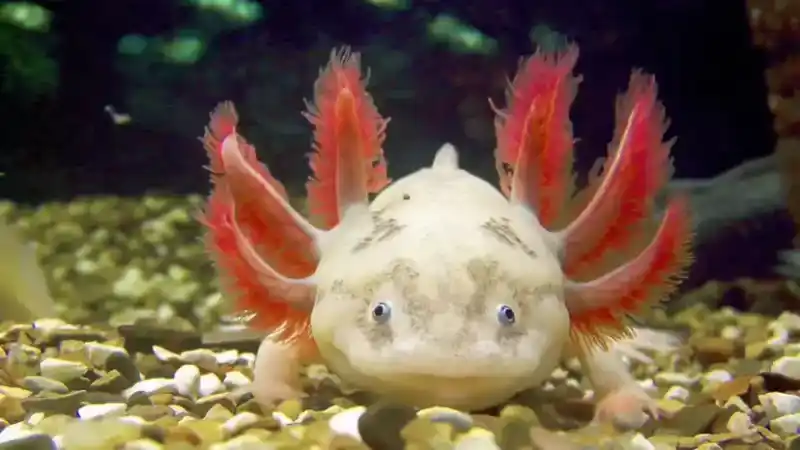
The axolotl (also known as the Mexican axolotl) is an endangered species, nicknamed the "walking fish," but it's actually an amphibian. Take a look at this photo, and you'll understand why they're so popular in the pet market.
Where do axolotls live?
The axolotl is a large, entirely aquatic salamander native to the Xochimilco Lake region south of Mexico City.
They can only live in:
Cool, oxygen-rich fresh water
Waterways, swamps and lakes that never dry up
Although often called "Mexican walking fish", they are not fish , but amphibians that live their entire lives in water.
What do axolotls look like? Why do they look so "alien"?
Wild axolotls are typically dark brown or black with small spots, which helps them to blend well into the lakebed.
In artificial breeding, it is commonly seen that:
Pink leucistic
gold
All white, red eyes
All black (melanoid)
These colors come from long-term laboratory breeding and selection in the pet market.
Neoteny characteristics of the American axolotl
American axolotls retain their juvenile appearance throughout their lives, including:
Feather-like external gills
A rounded, flat, and wide head
A face shape resembling a "smile"
translucent skin
Small and soft webbed feet
Long tadpole-shaped tail fin
Because they do not need to live on land, they do not need to grow strong limbs, but instead rely on their tail fins to propel themselves in the water.
Why do axolotls always remain in a "juvenile" state?
Scientific research suggests that the continued larval stage of the axolotl is related to the high stability of its native habitat:
Environmental factors leading to persistent neoteny
The annual water temperature variation is minimal.
The waterway never dries up
Extremely low predation pressure
Water bodies are relatively closed and stable
In contrast, other salamanders, such as the tiger salamander, live in wetlands that may dry out, and therefore must undergo metamorphosis to breathe with lungs and survive on land.
However, the axolotl does not face this ecological pressure, so it retains its larval form.
Life cycle and reproduction of the axolotl
In captivity, the lifespan of the axolotl can reach 10–15 years ; in the wild, it is only 5–6 years .
Reproduction process
They reach sexual maturity at around 1 year old.
February is the breeding season in the wild, and males attract females with a "tail dance".
After the female gently touches the tip of the male's nose, the male releases his spermatophore.
The female collects the spermatophore, which then fertilizes the spermatophore.
The female will lay hundreds of eggs , which will attach to aquatic plants or rocks.
Without parental care , the young animals must survive independently.
After hatching, the larvae must immediately search for tiny prey, and may even gently bite the tails or feet of their siblings. Fortunately, they have a strong regenerative ability.
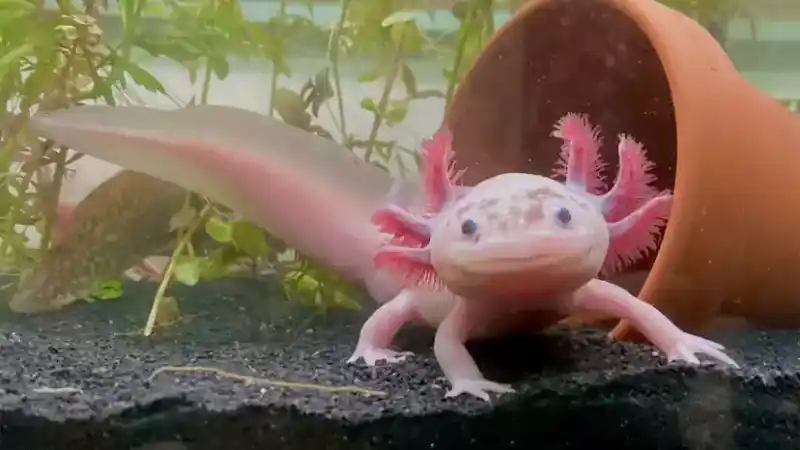
A Mexican axolotl, like this spotted albino axolotl, can live happily for up to 15 years in captivity, but only about five or six years in the wild.
The hunting habits of the axolotl: cute on the outside, "fierce" on the inside.
Although they may look gentle and cute, axolotls are agile underwater predators.
Wild food includes:
Insect larvae
Earthworms, water worms
Mollusks
Little Fish
Aquatic insects
Small crustaceans
They feed by sucking, quickly drawing their prey into their mouths.
Amazing regenerative abilities: Nature's "resurrectors"
Axolotls can regenerate almost any body part, including:
limbs
spinal cord
Heart tissue
Eye
Parts of the brain
Muscles and cartilage
Moreover, the regeneration process leaves no scars , an extremely rare ability among vertebrates.
Why does the scientific community attach so much importance to the axolotl?
Because they help scientists understand:
Possibilities of Regenerative Medicine
Neural repair
Embryonic development mechanism
Stem cell activation
Scarless healing process
The axolotl thus became one of the earliest, largest, and longest-lasting groups of laboratory animals in history.
Dangers faced by wild axolotls
Despite their remarkable self-healing abilities, axolotls are unable to combat the modern environmental crisis.
The main threats include:
Severe pollution caused by the aging sewage system in Mexico City
Invasive fish species (tilapia, carp) prey on eggs and compete for food.
Wetlands are being encroached upon by urban expansion and agriculture
Habitat fragmentation and waterway loss
These threats led to the American axolotl being listed as Critically Endangered (CR) by the IUCN.
Conservation efforts: Rebuilding the ancient "floating island ecosystem"
To save the axolotl, the Mexican government and several conservation agencies are undertaking a series of actions.
The main strategies include:
Restoring the aquatic plants and purification system of Sochimilco water body
Eliminate invasive fish
Reconstructing the traditional Aztec floating islands of Chinampas
Establish safe waterways for axolotl breeding
Artificial breeding and release
Develop ecotourism to fund conservation projects
The aquatic plants in Chinampa not only serve as habitats for axolotls but also filter toxins from the lake water, making them crucial for ecological restoration.
Captive-bred axolotls: far outnumber those in the wild
Despite being endangered in the wild, the axolotl is found in large numbers in laboratories and pet markets, making it one of the most widely kept amphibians in the world.
Precautions for breeders
Regulations vary from place to place; some areas prohibit raising them.
The aquarium must be completely filled with water (at least 15–20 gallons).
Do not touch or pick up axolotls, as their skin is extremely fragile.
Do not keep them together, and you should never keep two axolotls together.
Maintain low water flow, low temperature, high oxygen, and clean water quality.
Although not difficult to raise, as a "critically endangered species", it must be raised responsibly.
The last interesting point
The genome of the axolotl is the second largest of any sequenced animal genome , after that of the lungfish. This vast and complex DNA adds immense potential to regeneration and genetic research.