Octopuses belong to the cephalopod class and are marine invertebrates with eight sucker arms. They possess the largest brains among invertebrates, and their intelligence and behavioral performance are particularly remarkable. So, do you know how octopuses reproduce? This article will give you a comprehensive understanding of the octopus's reproductive process, including courtship, mating, spawning, and larval development, revealing the unique reproductive behaviors of these mysterious marine creatures.
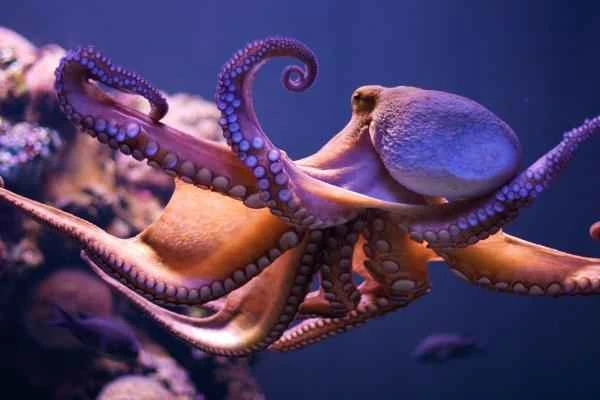
Table of contents
Octopus courtship behavior
The mating process of octopuses
Octopus spawning methods
Octopus embryonic development and hatching
Characteristics and habits of octopus larvae
Octopus courtship behavior
Octopus reproduction begins with the courtship phase, where males and females approach each other by swimming, usually at intervals of a few seconds. In most cases, it is the female who initiates the courtship by approaching the male.
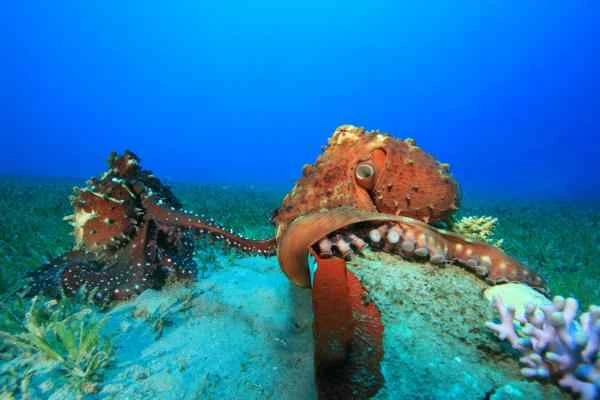
During courtship, male octopuses display suckers on their tentacles and sometimes unfold the "umbrella" connecting the tentacles to show off their larger size and attract females. Some species, such as the Patagonian red octopus ( Enteroctopus megalocyathus ), occasionally change their body color, while the blue octopus ( Octopus cyanea ) undergoes dramatic color changes as a courtship display.
Because octopuses do not have obvious sex characteristics, they mainly identify the opposite sex through chemotaxis (chemotaxis). Then, the two communicate by lightly touching their tentacles. The contact time varies from 5 seconds to 1 minute. After completing the courtship contact, they enter the mating stage.

The mating process of octopuses
Octopuses are oviparous animals. Males have one testis that stores sperm, while females have a single ovary. Male octopuses use specialized tentacles called "hemagglutination arms" to place spermatophores (spermatic capsules) containing sperm near the female's oviduct, thus achieving internal fertilization.
Males reach sexual maturity early and can mate year-round; females can store sperm and fertilize them when they are mature. Mating in deep-sea and benthic octopuses is mostly accomplished over long distances through their hemagglutination arms, although some males may climb onto the female's back to mate directly.
Mating typically lasts 30 to 80 minutes, but in some cases, several males mate with a single female simultaneously. Most octopuses reproduce only once in their lifetime, and the males die within a few months after mating.
Octopus spawning methods
Octopuses select suitable rocks or crevices as spawning grounds according to seasonal changes to improve the survival rate of their larvae. Spawning can be done individually or in groups, with the eggs attaching to the base or egg mass via filamentous structures at the ends.
The number of eggs laid varies depending on the species, ranging from dozens to 100,000. Polyandry is common, meaning that a single clutch of eggs may belong to multiple fathers.
Octopus embryonic development and hatching
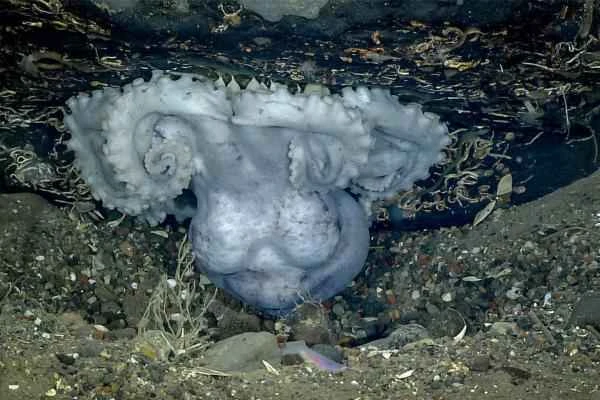
The incubation period for octopus eggs varies from approximately 25 to 125 days, depending on the temperature. During incubation, the female is responsible for guarding and cleaning the egg mass to prevent the invasion of parasites and bacteria, while also ensuring the eggs are oxygenated by spraying water.
Females undergo a process known as "self-sacrifice" after their eggs hatch due to prolonged fasting, resulting in rapid weight loss and eventual death.
Characteristics and habits of octopus larvae
Newly hatched octopus larvae are called "planktonic larvae". They are about 3 millimeters long and have three suckers on each arm, which allow them to float by surface tension.
From the day they hatch, the larvae become predators, feeding on small crustaceans and plankton, and sometimes also on decaying matter. After 30 to 60 days of planktonic life, the larvae develop into juvenile octopuses and begin to settle on the seabed.
If you would like to learn more about octopus species, habits, and other related information, please visit our [Wildlife Special].
Octopuses belong to the cephalopod class and are marine invertebrates with eight sucker arms. They possess the largest brains among invertebrates, and their intelligence and behavioral performance are particularly remarkable. So, do you know how octopuses reproduce? This article will give you a comprehensive understanding of the octopus's reproductive process, including courtship, mating, spawning, and larval development, revealing the unique reproductive behaviors of these mysterious marine creatures.
Table of contents
Octopus courtship behavior
The mating process of octopuses
Octopus spawning methods
Octopus embryonic development and hatching
Characteristics and habits of octopus larvae
Octopus courtship behavior
Octopus reproduction begins with the courtship phase, where males and females approach each other by swimming, usually at intervals of a few seconds. In most cases, it is the female who initiates the courtship by approaching the male.
During courtship, male octopuses display suckers on their tentacles and sometimes unfold the "umbrella" connecting the tentacles to show off their larger size and attract females. Some species, such as the Patagonian red octopus ( Enteroctopus megalocyathus ), occasionally change their body color, while the blue octopus ( Octopus cyanea ) undergoes dramatic color changes as a courtship display.
Because octopuses do not have obvious sex characteristics, they mainly identify the opposite sex through chemotaxis (chemotaxis). Then, the two communicate by lightly touching their tentacles. The contact time varies from 5 seconds to 1 minute. After completing the courtship contact, they enter the mating stage.

The mating process of octopuses
Octopuses are oviparous animals. Males have one testis that stores sperm, while females have a single ovary. Male octopuses use specialized tentacles called "hemagglutination arms" to place spermatophores (spermatic capsules) containing sperm near the female's oviduct, thus achieving internal fertilization.
Males reach sexual maturity early and can mate year-round; females can store sperm and fertilize them when they are mature. Mating in deep-sea and benthic octopuses is mostly accomplished over long distances through their hemagglutination arms, although some males may climb onto the female's back to mate directly.
Mating typically lasts 30 to 80 minutes, but in some cases, several males mate with a single female simultaneously. Most octopuses reproduce only once in their lifetime, and the males die within a few months after mating.
Octopus spawning methods
Octopuses select suitable rocks or crevices as spawning grounds according to seasonal changes to improve the survival rate of their larvae. Spawning can be done individually or in groups, with the eggs attaching to the base or egg mass via filamentous structures at the ends.
The number of eggs laid varies depending on the species, ranging from dozens to 100,000. Polyandry is common, meaning that a single clutch of eggs may belong to multiple fathers.
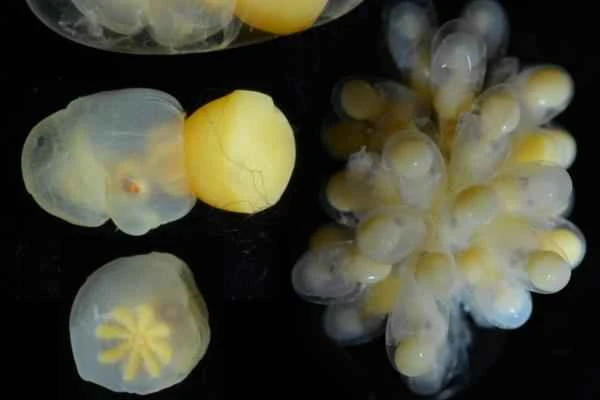
Octopus embryo development and hatching
The incubation period for octopus eggs varies from approximately 25 to 125 days, depending on the temperature. During incubation, the female is responsible for guarding and cleaning the egg mass to prevent the invasion of parasites and bacteria, while also ensuring the eggs are oxygenated by spraying water.
Females undergo a process known as "self-sacrifice" after their eggs hatch due to prolonged fasting, resulting in rapid weight loss and eventual death.
Characteristics and habits of octopus larvae
Newly hatched octopus larvae are called "planktonic larvae". They are about 3 millimeters long and have three suckers on each arm, which allow them to float by surface tension.
From the day they hatch, the larvae become predators, feeding on small crustaceans and plankton, and sometimes also on decaying matter. After 30 to 60 days of planktonic life, the larvae develop into juvenile octopuses and begin to settle on the seabed.
If you would like to learn more about octopus species, habits, and other related information, please visit our [Wildlife Special].
bibliography
Alejo-Plata, MDC, Gómez-Márquez, JL, Ramos Carrillo, S., and Herrera-Galindo, JE (2009). Reproduction, diet, and fisheries of the octopus (Octopus hubbsorum) (mollusc: cephalopod) off the coast of Oaxaca, Mexico. Journal of Tropical Biology, 57(1-2), 63-78.
Castellanos Martinez, S. (2008). Octopus bimaculatus Verrill, breeding in Los Angeles Bay, Baja California, Mexico, 1883 (Doctoral dissertation, Interdisciplinary Center for Marine Sciences, National Institute of Technology).
Gutiérrez, R., Farías, A., Yany, G., & Uriarte, I. (2012). Male-female interactions in mating behavior of the Patagonian red octopus Enteroctopus megalocyathus (Cephalopoda: Octopidae). Journal of Latin American Aquatic Research, 40 (Special Issue), 808-812.
Seixas, PF (2009). Biochemical composition and growth of octopus larvae (Octopus vulgaris Cuvier, 1797) feeding on Artemia larvae rich in microalgae and other nutrient supplements. University of Santiago de Compostela.