I. Introduction: Why does salt, which seems harmless, make snails turn pale at the mere smell of it?
In daily life, we often hear that "sprinkling some salt can repel snails," but have you ever wondered why salt has such a strong effect on snails? The snails' fear of salt is not superstition, but a scientific phenomenon supported by profound physiological and chemical mechanisms.
II. Characteristics of Snail Body Structure
2.1 The mucus system on the surface of snails
Snails are mollusks whose bodies are covered with a layer of mucus secreted by mucous glands. This mucus not only reduces friction and helps snails move, but also keeps their bodies moist, which is essential for their survival.
2.2 Osmotic Balance of Body Fluids
Snails contain a large amount of water in their bodies, and their physiological system is very sensitive to the osmotic pressure of their body fluids. Once the balance is disrupted, it can lead to a series of fatal problems such as dehydration.
III. The Physiological Effects of Salt on Snails
3.1 Osmotic pressure principle triggers dehydration
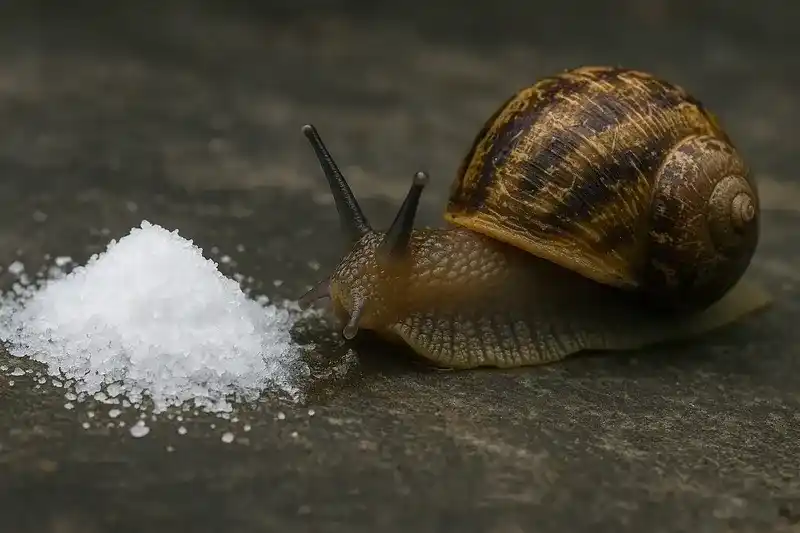
The main component of table salt is sodium chloride (NaCl). When sprinkled on the surface of a snail, the salt absorbs water from the mucus, forming a hypertonic solution. This external hypertonic environment causes water to flow out of the snail's body through osmosis, leading to rapid cell dehydration.
3.2 Cell structure destruction and tissue necrosis
As water is rapidly lost, the snail's cells begin to shrink, cell membranes rupture, and tissues die. This dehydration reaction can be fatal within minutes, which is why snails are extremely sensitive to salt.
IV. Behavioral Stress Response
4.1 Instinctive escape behavior
When a snail senses the presence of salt, it quickly retracts its body and tries to move away from the area in contact with the salt; this is an instinctive self-protective behavior.
4.2 Memory and avoidance learning of salt
Studies have shown that some mollusks have a certain learning ability, and snails may also develop a memory of salt stimulation after experiencing it, thus forming an avoidance response.
V. History and Practical Application of Salt-Driven Snails
5.1 Traditional Practices in Horticulture
In the field of horticulture, sprinkling salt to repel snails is an ancient practice, but it is gradually being replaced by more environmentally friendly methods because salt can damage soil structure and plant growth.
5.2 Alternative Solutions: Physical and Ecological Control
Using physical barrier materials such as iron-phosphorus particles, copper strips, and eggshell fragments is more in line with the principle of ecological protection.
VI. Conclusion: Understand animal behavior scientifically and reject inhumane treatment.
Snails' aversion to salt is a natural response to their fragile physiological structure. Understanding this helps us treat these tiny creatures more rationally in our lives, avoiding unnecessary harm and choosing more environmentally friendly and humane control methods.