Birds are the second largest and most diverse group of vertebrates on Earth. Currently, approximately 10,000 extant bird species have been described, with an estimated additional 10,000 unidentified species. To easily identify and distinguish individuals of each species, biologists, taxonomists, and ornithologists have grouped and classified them based on their morphological, phylogenetic, and behavioral characteristics.
This article shows you some of the most common bird classifications, from orders of birds according to taxonomy to bird types classified according to different criteria, such as their abilities in certain aspects or their relationships with other birds and humans.
Characteristics of birds
Birds are classified according to their order.
Classification based on bird anatomy
Classification based on birds' mobility
Classification based on bird diet
Birds are classified according to their habitat.
Birds are classified according to their relationships with other birds.
Classification based on the relationship between birds and humans
Characteristics of birds
Regardless of order, family, or genus, all modern birds share the following characteristics:
Birds are a group of animals belonging to the animal kingdom, phylum Chordata, and subphylum Vertebrata.
They are heterotrophic, aerobic, warm-blooded organisms with a very fast metabolism.
They are quadrupeds and bipeds. Their forelimbs have evolved into wings, and although not all of them can fly, the vast majority can.
They have a four-chambered heart, a cloaca, and a hollow skeleton for easy flight.
Their bodies are almost entirely covered in feathers and they have no sweat glands.
They have toothless beaks, which they use to grasp and swallow food.
Their feet are covered with scales, and most species have four toes on each foot.
They reproduce sexually through eggs (oviparous), and over 95% of species are monogamous during one or more breeding seasons.
We can classify birds in many ways: according to their taxonomy, anatomy, locomotion, diet, habitat, and even their relationship with other birds and humans.
Birds are classified according to their order.
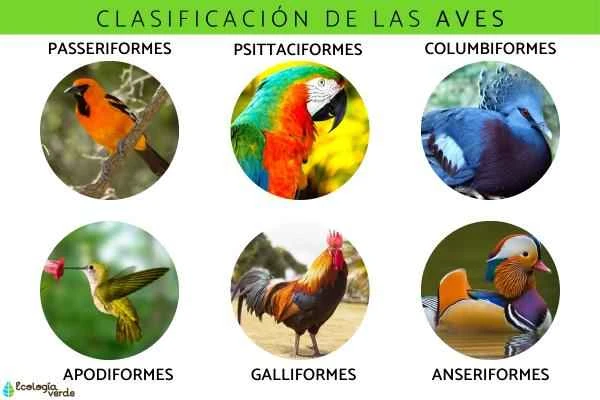
From a taxonomic perspective, we can classify birds simply and effectively according to their order. Birds belong to many orders, but the most representative are:
Passeriformes: The most diverse order of birds in the world. It comprises 5,700 to 6,500 species, whose members are commonly referred to as birds or songbirds. They are characterized by their small size, ability to fly, nesting ability, and having four toes on each foot. The most representative species in this order include canaries, sparrows, finches, crows, and goldfinches.
Apodiformes: An order comprised of hummingbirds, swifts, and swiftlets. It is the second most diverse order of birds, currently containing approximately 450 species. Its most distinctive feature is its lower legs.
Woodpeckers: This order includes woodpeckers, toucans, and false woodpeckers. It is estimated that there are between 340 and 450 species of Muscicapidae. Most species are zygodactyls.
The order Psittaciformes, or family Psittacidae, comprises nearly 400 species of parrots and cockatoos. They are characterized by their habitat in tropical and temperate regions, thick, curved beaks, and zygodactyl legs with claws. Macaws, budgerigars, lovebirds, and cockatoos all belong to this order.
Columbiformes: Pigeons and doves belong to this order. It consists of approximately 350 extant small to medium-sized herbivorous birds and birds, as well as more than 10 extinct bird species (of which the dodo is particularly prominent).
Charadriiformes: This order includes more than 350 species that live and forage near water. It includes gulls, plovers, and puffins.
Galliformes: These are terrestrial domestic fowl. This order includes nearly 300 species, including chickens, turkeys, peacocks, partridges, quails, and guacharacas. They are not strong fliers, and most species exhibit significant sexual dimorphism.
Anseriformes: These are aquatic poultry. This order includes more than 160 species, including barnacles, ducks, geese, and swans. Most are flying, migratory, and herbivorous.
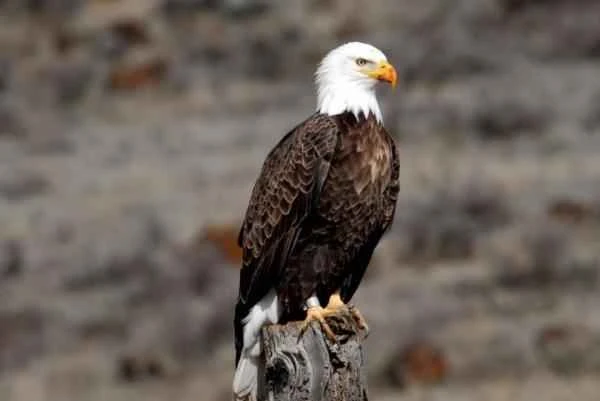
Falconiformes: Over 300 species of diurnal birds of prey. They are characterized by excellent eyesight, hooked beaks, and long, sharp talons. This order includes eagles, vultures, and hawks, as shown in the image below.
Strigiformes (or Strigiformes order): Nocturnal birds of prey, comprising over 200 species. They possess excellent hearing, dense plumage, and large, forward-facing eyes. Owls and barn owls belong to this order.
Pelecaniformes: This order includes more than 70 species, such as pelicans and herons. They have webbed feet with four toes on each foot and mainly feed on fish and shellfish.
The order Ciconiiformes comprises nearly 20 species of wading birds, waterfowl, and long-necked birds. Storks, flycatchers, and marabou storks all belong to this order.
Sphenisciformes: These are flightless seabirds. All 17 extant species of penguins belong to this order.
Ostrichoidea: This group includes ostriches and other extinct flightless birds.
Flamingoes: A group consisting of flamingos, flamingos, and their extinct relatives.
Some other important orders of birds are: Craniformes, Craniformes, Trolliformes, Trollariiformes, Trolliformes, Trollariiformes, Trollariiformes, Apteryths, Sheriformes, Tigers, Bergamoriformes, Bergamoriformes, Cruciformes, Trollariiformes, Trollariiformes, Trollariiformes and Crocodiformes.
Classification based on bird anatomy
We can classify birds in various ways based on their anatomical features.
Classification based on bird size
Depending on its size, a bird may or may not be a bird. Some authors claim that if a bird is less than half a meter tall and weighs less than 1 kilogram, it is a bird.
As examples of birds, and therefore small species, we have the Yellow Weaver, the Wild Canary, and the Australian Long-tailed Parrot.
Examples of non-avian (i.e., large birds) species include blue-and-gold macaws, pelicans, and ostriches.
Birds can be classified according to their beaks.
The shape and size of the beak can be used to infer a species' diet. There are many types of beaks, each with a specific function. Some types are characterized by:
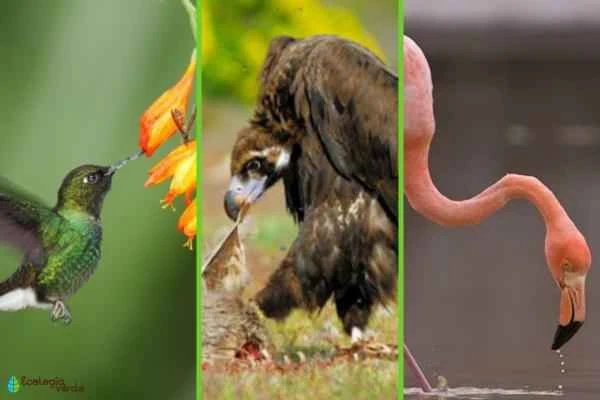
Short, hooked beak: a characteristic of birds of prey and scavengers. They use it to tear meat into small pieces. Eagles and owls have short, hooked beaks.
Long, slender beaks: ideal for catching fish, mollusks, and other small invertebrates. They are typical aquatic fishing birds. Herons and storks also have this type of beak.
Short, thick, and sturdy picks: very useful for cracking open seeds and nuts. Red-bellied finches, songbirds of the finches family, goldfinches, and hens all have this type of beak.
A very slender and long beak: used to suck nectar from flowers. Hummingbirds are characterized by having this type of beak.
Broad, flat beak: Filter-feeding birds have broad, flat beaks that enable them to filter food from the water. Ducks, geese, and swans use broad, flat beaks to forage efficiently. You can see an example in the image below.
Classification based on birds' legs
The number of toes, the presence of claws, and the size of the legs can determine a species’ locomotion and whether it has the ability to swim, climb, run, or hunt.
Based on the number of toes, birds can be divided into two-toed birds (each foot has two toes, like ostriches), three-toed birds (each foot has three toes, like llamas), or four-toed birds (each foot has four toes, like passerine birds).
Based on the arrangement of their toes, birds can be divided into odd-toed birds, syndactyl birds, didactyl birds, heterodactyl birds, or holopactyl birds.
If it has sharp, downward-curving claws, it is a bird of prey (such as an eagle or owl).
If they have webbed feet and webbed toes, then they are water birds (such as ducks and penguins).
Classifying birds based on other physical characteristics
By observing a bird's feathers, you can learn a great deal about it. For example, based on the thickness and color of its feathers, one can determine whether it is a species living in extremely cold climates (such as penguins) or a species that uses its feathers to attract mates during the mating season (such as peacocks). Sexual dimorphism is also an indicator of a species' courtship and mating rituals. Birds of paradise, pheasants, and peacocks exhibit significant sexual dimorphism.

Classification based on birds' mobility
Based on their mode of locomotion, birds can be flightless or flightless, running or non-running, swimming or non-swimming. For example:
Passeriformes, parrotiformes, and falconiformes are adept at flying, not swimming.
Kiwis and kakapos are flightless reptiles.
Ostriches, emus, rheas, and cassowaries are all flightless, running birds.
Penguins are flightless swimming birds.
Ducks, geese, swans, and pelicans are birds that fly and swim.
Ten types of flightless birds were discovered here.

Classification based on bird diet
Depending on their diet, birds can be herbivores, carnivores, or omnivores.
Herbivorous birds, such as parrots, pigeons, and hummingbirds, feed on plants, fruits, grains, nuts, seeds, and/or nectar.
Birds of prey, such as eagles, vultures, and woodpeckers, can be insectivorous, fishing birds, scavengers, and/or birds of prey, raptors, or birds of prey.
Sparrows and flamingos are omnivorous birds that feed on a mixed diet, including plants and small animals such as insects, frogs, fish, crustaceans, and/or lizards. You can read more about what flamingos eat here.
Birds are classified according to their habitat.
Here we classify birds according to their habitats:
Depending on whether they are permanent residents, they can be migratory birds (such as swallows) or resident birds (such as guacharacas). Read more articles about migratory birds: names and photos.
Depending on their ecosystem, they can be terrestrial animals (such as ostriches), aquatic animals (such as penguins), or semi-aquatic or amphibian animals (such as ducks). Here we will talk more about waterfowl: characteristics, species, and names.
If they spend a lot of time at sea, they are called seabirds (such as gannets).
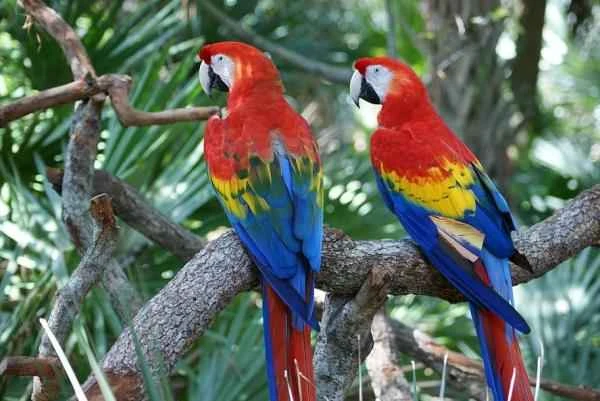
If they spend a lot of time in the trees, they are called arboreal birds (like the parrots shown in the picture below).
If they cannot fly and spend most of their time on the ground, then they are called reptiles (such as kiwis and chickens).
If they prefer to live near or in human settlements such as cities or suburbs, they are called urban birds (e.g., pigeons, magpies, sparrows, and vultures).
Birds are classified according to their relationships with other birds.
We can summarize bird classification based on the following criteria, according to the relationships between birds:
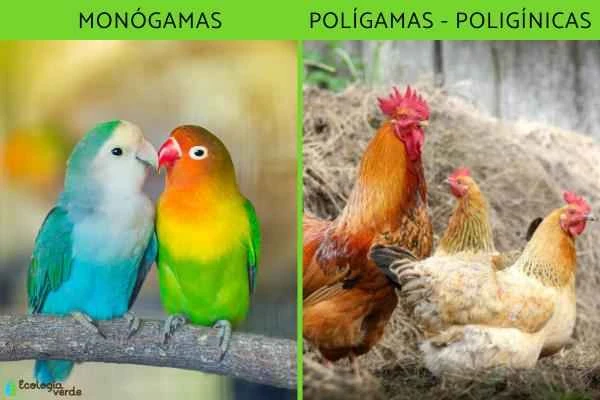
Most birds are monogamous, with some species forming lifelong relationships with a single partner, such as swans and lovebirds. Non-monogamous birds tend to be polygamous or form harems, such as roosters, rheas, and peacocks.
When a bird prefers to live and move around in large groups of its own kind, it is said to be part of a flock, sheep, or herd. Common queurbirds, ducks, and guinea fowl often form large flocks.
Some gregarious birds can live happily together with other types of birds. This behavior is common among parrots, penguins, and ducks.
Classification based on the relationship between birds and humans
Another interesting classification of these animals is their relationship to us:
Birds domesticated for food or commercial purposes are called poultry. Chickens, turkeys, and ducks are all poultry.
When a bird species struggles to integrate into family life, it is referred to as a wild species, as is the case with hummingbirds and birds of prey.
When a bird species is endangered or critically endangered, it becomes a protected species, like the California condor and the green macaw.
Birds kept as pets are called songbirds and/or companion birds, such as the King Parrot and the Australian Long-tailed Parrot. Here you can find 13 species of singing birds.
Finally, we would like to clarify that there are many ways to classify birds. For example, they can be divided into diurnal and nocturnal birds, depending on whether they are more active at certain times of the day or at other times, but there are many more criteria for classifying species.