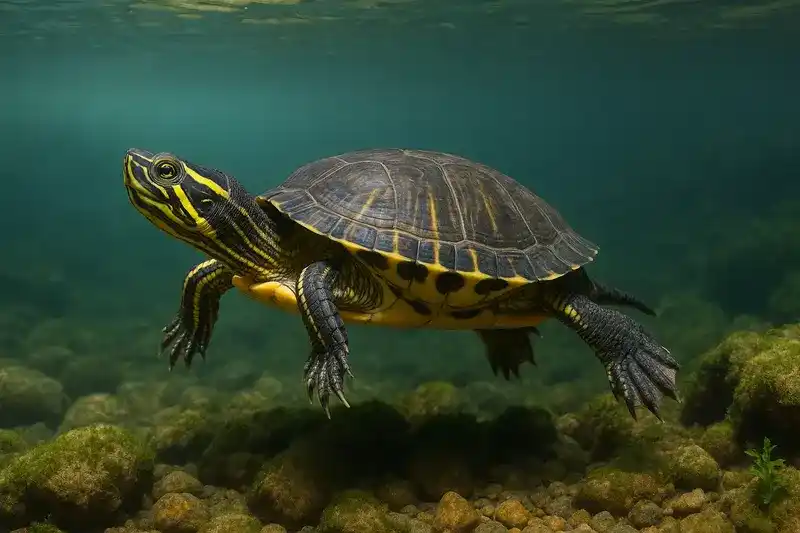
The Yellow-margined Box Turtle (scientific name: *Mauremys mutica*), commonly known as the Yellow-margined Box Turtle, is a semi-aquatic turtle widely distributed in southern China and Southeast Asia. It is often kept in captivity and is highly popular among turtle enthusiasts. However, many keepers still have doubts about whether the Yellow-margined Box Turtle belongs to the category of "deep-water turtles." This article will systematically explore the Yellow-margined Box Turtle's habitat preferences, aquatic activity characteristics, and deep-water adaptability from the perspectives of animal ecology and behavior.
I. Natural Distribution and Habitat of the Yellow-margined Turtle
1.1 Geographical Distribution Range
The yellow-throated turtle is mainly distributed in southern China (such as Fujian, Guangdong, Guangxi, Hainan, and Taiwan), as well as Vietnam, Laos, and the Ryukyu Islands of Japan. It is adapted to warm and humid subtropical and tropical climates.
1.2 Habitat
Yellow-margined turtles prefer slow-flowing or still water environments, including:
farmland irrigation ditches
lake edge
shallow stream
paddy field irrigation canals
These bodies of water are usually not deep, ranging from 10 to 60 centimeters, and have abundant vegetation and underwater hiding structures.
II. Shallow Water or Deep Water? Behavioral and Physiological Judgments
2.1 Respiratory rate and water surface dependence
Yellow-margined turtles are lung-breathing animals and need to frequently surface to breathe. In deep water environments, if they cannot easily reach the surface, they may face the risk of drowning.
2.2 Limb structure and swimming ability
Its limbs have partial webbing, giving it moderate swimming ability and adapting it to shallow or medium-depth waters. However, compared to deep-water turtles (such as red-eared sliders and map turtles), its swimming agility and underwater endurance are weaker.
2.3 Prefers quiet to flow
Yellow-margined turtles are not adapted to turbulent water environments and prefer to move and forage in areas with slow or still water, which also reflects their poor adaptability to "deep water + flowing water" environments.
III. Behavioral Characteristics of the Yellow-throated Turtle
3.1 Daytime activities, nighttime rest
Yellow-throated turtles are more active during the day, often swimming in the water, basking, or foraging on the shore, while at night they hide at the bottom of the water or among aquatic plants.
3.2 Enjoys sunbathing on its back
They exhibit sunbathing behavior, requiring them to climb into shallow water or onto floating islands or rocks to bask in the sun, which helps promote metabolism and vitamin D synthesis.
3.3 High frequency of landing
Unlike typical deep-water turtles, the yellow-margined turtle is more often active and resting on land, indicating that it is a semi-aquatic rather than fully aquatic turtle.
IV. Recommendations for Water Depth in Artificial Rearing
4.1 Ideal water depth
For juvenile turtles: a water depth of 5-15 cm is recommended to ensure they can easily surface their heads to breathe.
Adult turtles: A water depth of 20-40 cm is most suitable, with multiple platforms or rocks provided as access routes.
4.2 Water conditions
Slow or no water flow
Clean water and change the water regularly.
Include environmental enrichment elements such as basking platforms, hiding places, and aquatic plants.
V. Habitat Depth Compared with Other Turtles
| turtle species | Habitat water body types | Is it suitable for deep water? | Features |
|---|---|---|---|
| Yellow-throated turtle | Still water/shallow water | no | They are semi-aquatic and require frequent air exchange and basking. |
| Brazilian turtle | Lakes/Deep Ponds | yes | Strong swimming ability, long duration of deep-water activity |
| Map turtle | River/Deep Pool | yes | Good swimmers need a wide body of water. |
| grass turtle | Pond/Stream | no | Similar to the yellow-throated turtle, a moderate water depth is best. |
VI. Conclusion: The yellow-margined box turtle is not a deep-water turtle.
Based on a comprehensive analysis of its natural habits, physiological structure, and behavioral patterns, the yellow-margined box turtle is not a typical deep-water turtle. It is better adapted to shallow or moderately deep, still water environments, enjoys basking, and frequently comes ashore, making it a typical "semi-aquatic turtle." In captivity, excessively deep water should be avoided to prevent suffocation, stress, and decreased appetite. A scientific understanding of its ecological needs helps improve the quality of care and the turtle's health.