The Bichon Frise, with its curly, white coat, lively personality, and friendly nature, is beloved by families. However, this small breed can also be playful and easily distracted, and improper training can lead to behavioral problems. This article will systematically introduce Bichon Frise training methods from an animal behavior perspective to help owners establish a good foundation for communication and behavioral habits.
I. Understanding the behavioral characteristics of Bichon Frises
1.1 Intelligent but stubborn
Bichon Frises are quick learners and can master commands rapidly, but they can also be willful and selectively obedient at times.
1.2 Enjoys being noticed
Bichon Frises are naturally affectionate and crave companionship, making them suitable for training that uses positive attention to motivate them.
1.3 Highly energetic, easily distracted
Bichon Frises are sensitive to environmental stimuli and are easily attracted by sounds or new things, requiring a structured training process.
II. Preparations before training
2.1 Define training objectives
Defecation point
Wait quietly
Social skills
Follow basic instructions (such as sit down, wait, come here).
2.2 Preparing Training Tools
Small high-value snacks
Leash and collar (or chest harness)
Command Clicker (optional)
A quiet and undisturbed space
III. Basic Behavior Training for Bichon Frises
3.1 Toilet training
Set fixed times : such as taking your dog to a designated location upon waking up, after meals, or after exercise.
Immediate reward : Give the dog a treat or praise immediately after it has finished defecating.
Avoid punishment : If the child urinates or defecates indoors, do not use physical punishment; instead, observe and guide them.
3.2 Obedience Training
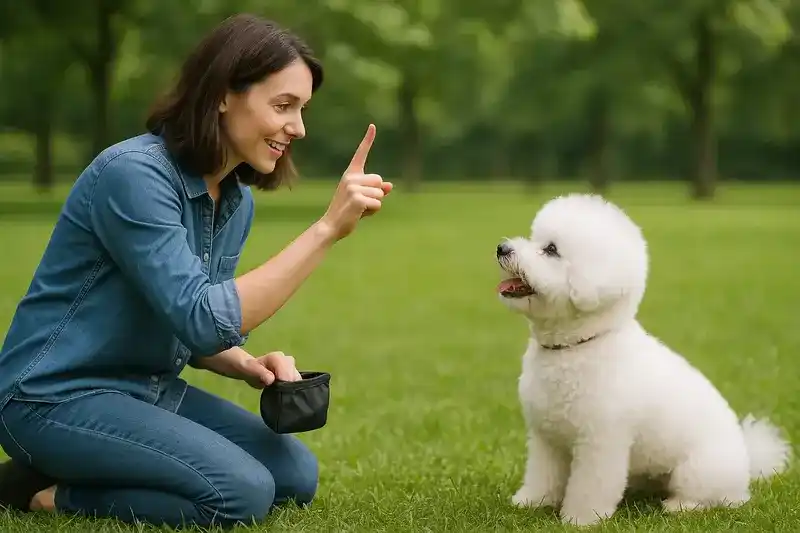
Sit : Guide the treat from the tip of its nose to its back, and the Bichon Frise will sit down naturally.
Stay : Train a Bichon Frise to wait in a specific location, gradually increasing the time.
Come : Use a high-value reward to attract the Bichon Frise to approach quickly after hearing its name.
IV. Behavior Correction and Socialization Training
4.1 Barking and Anxiety Management
Identify triggers such as doorbell rings, strangers, loneliness, etc.
Distract yourself : Use toys or training instructions to shift your attention.
Establish a "quiet" command : associate it with a reward to teach your Bichon Frise to stop barking when prompted.
4.2 Biting and gnawing
Provide appropriate chew toys
When a Bichon Frise bites, immediately let out a "Ouch!" sound of pain and move away to help it realize that its behavior was inappropriate.
4.3 Socialization Stage
Accumulate positive experiences by exposing Bichon Frises to different people, dogs, and environments during their 3-12 week age period.
Avoid forced social interaction and encourage exploration in a positive way.
V. Training Techniques and Precautions
5.1 Using positive reinforcement
All training should be based on rewards (snacks, touch, words).
Avoid using punishment or yelling to prevent distrust.
5.2 Training Time Control
Each training session should not be too long, 5-10 minutes is ideal, and multiple short training sessions per day will yield better results.
5.3 Maintain consistency
The whole family uses the same instructions and rules.
The response to rewards should be quick and consistent.
5.4 Observing Individual Differences
Each Bichon Frise has a different personality, and the training pace should be adjusted according to their reactions.
Be tolerant of setbacks and avoid being impatient.
VI. Advanced Training and Daily Management
6.1 Indoor Rules
Establish restricted areas (such as the kitchen).
Teaching instructions such as "don't" and "get down" to manage behavioral boundaries
6.2 Outdoor Behavior Training
Learn to walk with guidance
Training to remain calm when encountering strangers or dogs
Familiar with traffic and environmental noise
6.3 Skills Training
Activities like "shaking hands," "rolling over," and "finding objects" not only increase the fun of interaction but also enhance cognitive abilities.
VII. Common Problems and Solutions in Training
7.1 Lack of concentration
Use higher value snacks
Increase the fun of training or change the training environment
7.2 Resistance Training
Check if the training time is too long or the rewards are not attractive enough.
Revert to simple, familiar movements to rebuild confidence in your Bichon Frise
7.3 Training results are unstable
Strengthen practice in different contexts
Re-establish control capability after adding interfering factors
VIII. Conclusion: Scientific training leads to harmony between humans and dogs.
While Bichon Frises are small and adorable, training is essential. Through scientific, patient, and positive training methods, not only can good behavioral patterns be cultivated, but also a bond of trust and affection can be built between human and dog. Each Bichon Frise is a unique individual; the key is to understand and guide it, allowing it to grow freely within rules and become an ideal family companion.