The widely circulated claim that "one year in a cat equals seven years in a human" is actually inaccurate. A cat's physiological development and life cycle are fundamentally different from a human's. Cats grow extremely rapidly in their early years, but this growth rate gradually slows down later. To more scientifically understand a cat's "actual age," we need to consider multiple factors, including anatomy, physiological development, behavioral maturity, and disease risk, for calculation.
This article will analyze in detail the conversion relationship between cat age and human age from the perspective of animal experts, and explore the guiding significance of this conversion for cat care and health management.
1. What are the age differences between cats and humans?
1.1 Significantly different growth rates
Cats reach sexual maturity within one year of birth, while humans typically take more than ten years. This indicates that cats grow much faster than humans in their first year.
1.2 Comparison of Physiological and Psychological Maturity
A 3-month-old kitten already possesses basic social interaction abilities, equivalent to a 4-5 year old human child.
At 6 months old, they already show signs of sexual behavior, which is equivalent to puberty in humans.
1.3 Differences between disease and aging milestones
Cats are considered "senior cats" after the age of 7, which is equivalent to the middle-aged and elderly stage of humans (about 50 years and older), so their health management needs to be adjusted appropriately with age.
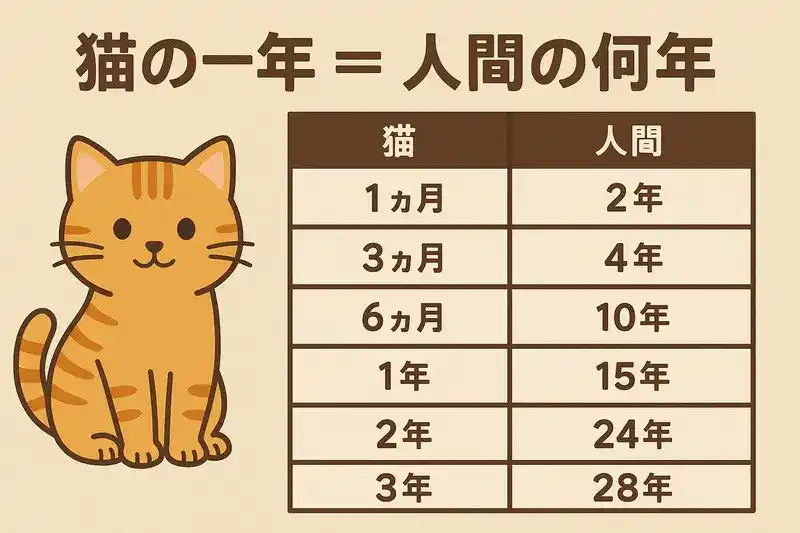
II. Scientific Conversion: Cat Age to Human Age Conversion Table
| cat's age | Equivalent to human age |
|---|---|
| 1 month | 1 year old |
| 3 months | 4 years old |
| 6 months | 10 years old |
| 1 year old | 15 years old |
| 2 years old | 24 years old |
| 3 years old | 28 years old |
| 4 years old | 32 years old |
| 5 years old | 36 years old |
| 6 years old | 40 years old |
| 7 years old | 44 years old |
| 8 years old | 48 years old |
| 9 years old | 52 years old |
| 10 years old | 56 years old |
| 11 years old | 60 years old |
| 12 years old | 64 years old |
| 13 years old | 68 years old |
| 14 years old | 72 years old |
| 15 years old | 76 years old |
| 16 years old | 80 years old |
| 17 years old | 84 years old |
| 18 years old | 88 years old |
| 19 years old | 92 years old |
| 20 years old | 96 years old |
III. Why was the growth rate particularly fast in the previous two years?
3.1 Evolutionary Strategies under Natural Selection
As small predators, cats have many natural enemies and must grow rapidly to survive. Therefore, cats develop quickly in their first year to reach reproductive capacity as soon as possible.
3.2 Critical Period for Behavioral Learning
The first six months are a critical period for the formation of a cat's social behavior, hunting skills, and territorial awareness, similar to the infancy to childhood stage in humans.
IV. When does a cat's senior years begin?
4.1 Age 7: Entering "Middle Age"
Early signs of aging may appear, such as weight fluctuations, dental problems, and reduced activity.
4.2 After age 10: Entering "old age"
They are prone to chronic diseases such as kidney disease, heart disease, and diabetes, and their immune function is weakened, requiring regular health checkups and nutritional supplements.
V. The significance of cat age conversion for care
5.1 Dietary Management
Kittens need high-energy protein
Pay attention to calorie control after adulthood
Senior cats need attention for kidney protection, easily digestible nutrition, and antioxidant nutrients.
5.2 Behavioral and Environmental Adjustment
Adolescent kittens (6 months to 2 years old) need plenty of toys and climbing frames to prevent destructive behavior.
Low platforms and warm mats are suitable for senior cats to reduce stress on their bones.
5.3 Vaccines and Health Screening
Vaccinations for children under 1 year old should be administered according to schedule.
It's safer to have a health check-up every six months after age 7.
VI. Conclusion: Understanding age is the beginning of better cat care.
Each year in a cat corresponds to several years of growth and change in a human. Understanding this age-related relationship not only helps us accurately assess a cat's physical and mental state but also enables us to provide them with scientific and precise care plans.
Cats can't speak, but their age tells you what stage they're in and what kind of care they need. May we both be the people who understand our cats best in their lives.