Fish are among the oldest and most widely distributed vertebrates on Earth, and their reproductive methods are diverse, fascinating, and ever-changing. From external fertilization to mouthbrooding, from sex change to egg parasitism, the world of fish reproduction is far more complex and fascinating than we imagine. As an animal expert, this article will comprehensively interpret the topic of "how fish reproduce," covering reproductive methods, behavioral characteristics, evolution of reproductive organs, and reproductive strategies in different ecological environments.
I. Main Reproduction Methods of Fish
1.1 In-vitro fertilization: the most common method of reproduction
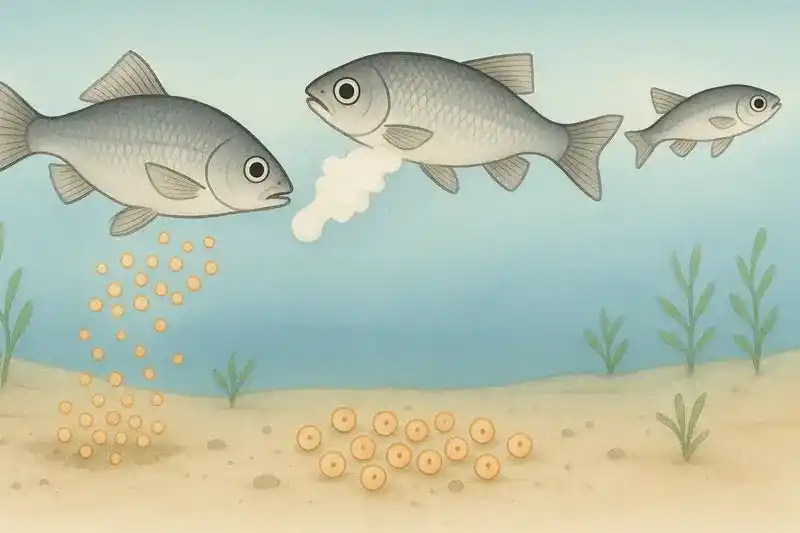
Most fish use external fertilization, where the female lays eggs, and the male releases sperm in the water to fertilize them. This method is commonly seen in carp, goldfish, and bass.
1.2 In-vivo fertilization: More developed reproductive system
Fish such as medaka, sharks, and rays use internal fertilization, where the male fish has a special copulatory organ (such as a gonopodium) that can directly deliver sperm into the female fish's body.
1.3 Oviparous, ovoviviparous, and viviparous
Oviparous : Most fish are oviparous, laying fertilized eggs that hatch from the external environment, such as crucian carp.
Ovoviviparous : The embryo develops inside the mother's body, but the source of nutrition is still the yolk, such as in guppies.
Viviparous : The embryo obtains nutrition directly from the mother and is born as a small fish, such as a few species of sharks.
II. Characteristics of Fish Reproductive Behavior
2.1 Courtship Display
Male fish attract females through color changes, swimming displays, and calls. For example, betta fish spread their fins and brighten their colors; male goldfish chase after females.
2.2 Nest-building behavior
Some fish species, such as bass, koi, and chub, will dig sand pits in the riverbed or build nests among aquatic plants for the female fish to lay eggs and protect the eggs.
2.3 Egg protection and rearing
Some fish exhibit obvious egg-guarding behaviors. For example, male map fish and flowerhorn cichlids will protect their eggs and drive away intruders. The mouthbrooding behavior of cichlids is particularly well-known, where parent fish hold the eggs or fry in their mouths to avoid predators.
III. Sexual Changes and Unique Reproductive Mechanisms
3.1 Reversible sex fish
Clownfish and groupers, for example, have the ability to change sex, altering their gender based on social structure or environment to achieve optimal reproductive strategies.
3.2 Asexual Reproduction and Parthenogenesis
A very small number of fish (such as some live medaka) can reproduce parthenogenetically, meaning they can reproduce without male sperm, but their genetic diversity is low.
3.3 Utilizing "sperm storage"
Some female fish have sperm sac structures that can preserve sperm obtained from mating for months or even more than a year, thus delaying fertilization.
IV. The Impact of the Ecological Environment on Reproductive Strategies
4.1 Seasonal breeding
Most fish breed during the seasons when temperature, water flow, and sunlight are most suitable, such as spring and summer, which is conducive to the growth of juvenile fish.
4.2 Impact of Hydrological Conditions
Rising water levels and faster water flow are often key factors that trigger fish spawning, especially in river ecosystems, such as the Chinese sturgeon migrating upstream to spawn.
4.3 Reproduction Migration
Some fish, such as salmon and eels, have a strong migratory instinct, swimming back from the ocean to their birthplace in freshwater rivers to reproduce, demonstrating amazing navigation abilities and a strong will to live.
V. Human Intervention and Artificial Reproduction
5.1 Artificial induction of labor
Hormones are commonly used in aquaculture to stimulate maturation, such as injecting gonadotropins into carp to induce spawning.
5.2 Artificial insemination
Fish eggs and fish sperm are collected, mixed externally, and then artificially hatched, and are used extensively for the breeding of economic fish species.
5.3 Gene Preservation and Embryo Freezing
To protect endangered fish species, humans have begun to use modern biotechnology such as embryo freezing and cloning to preserve fish genetic resources.
VI. Conclusion: Underwater Reproduction, the Continuation of Life and Wisdom
Fish reproduction is not simply about "giving birth," but a complex biological strategy for adapting to the environment, increasing survival rates, and perpetuating the species. In the vast waters, every mating, spawning, and hatching is a manifestation of the wisdom of life.
Understanding fish reproduction not only helps in aquarium keeping and aquaculture, but also gives us a deeper sense of awe and appreciation for the diversity of life and the mechanisms of natural evolution.