In short : Huskies (domestic dogs) and gray wolves share a common ancestor, but have diverged in domestication and ecological niche . Their physical resemblance is merely a result of "wolf-like" appearances; they exhibit systemic differences in genes, skeletal structure, behavior, social interaction, and human relationships . While so-called "half-wolf dogs" (wolfdogs) can exist, their potential for development, risks, and legality are far beyond the control of the average family.
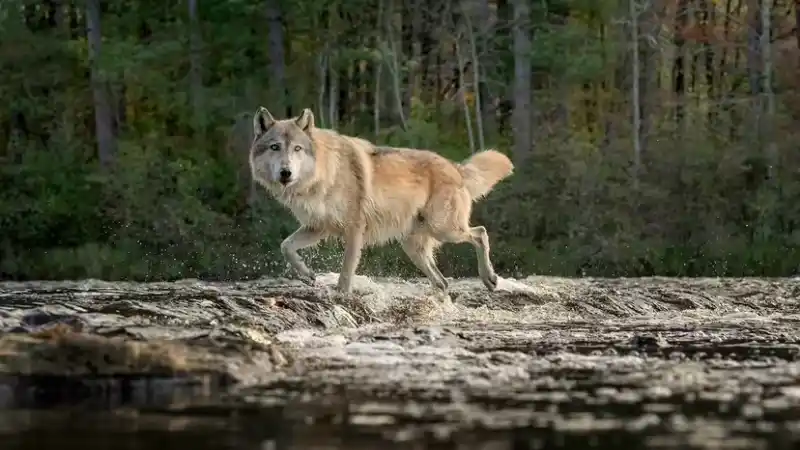
Table of contents
Quick Tips (TL;DR)
True identity: Domestic dog vs. wild animal
Physical and physiological differences: Don't just look at the face
Behavior and Social Structure: The Impact of Domestication Syndrome
Their relationship with humans and their working history: Why are Huskies "wolf-like yet affectionate"?
How is the "wolf-like appearance" formed?
Modern Differentiation and Heredity: Different Paths Within the Same Lineage
Is it safe to keep a wolfhound (half-wolf) as a pet?
Huskies vs. Wolves: Quick Comparison Table
Common Misconceptions & Safety Tips
FAQ
Quick Tips (TL;DR)
Identity : Husky = domestic dog subspecies ( Canis lupus familiaris ); Wolf = wild gray wolf ( Canis lupus )
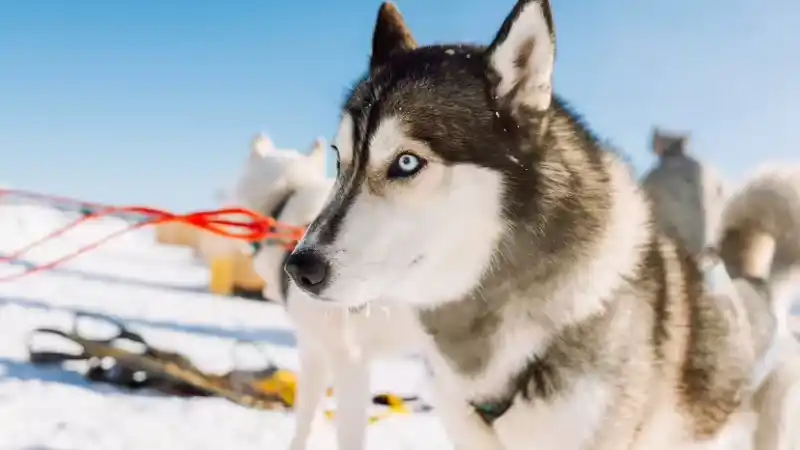
Appearance : Huskies come in various sizes, with erect ears, mask-like markings, and blue/heterochromia is common; wolves have longer limbs, deeper chests, more robust skulls, and eyes that are more amber/golden brown.
Behavior : Wolves avoid humans and employ sophisticated hunting strategies; Huskies are highly socialized and rely on human cooperation.
Domestication : Through thousands of years of artificial selection, domestic dogs have strengthened their dependence on and cooperation with humans.
Wolfdogs : Although they can interbreed, their behavior is unpredictable , and they are subject to many legal restrictions , making them unsuitable for ordinary families.
True identity: Domestic dog vs. wild animal
The Siberian Husky is a domestic dog breed, belonging to a subspecies of domestic dog . Their temperament, metabolism, and stress response have been domesticated and reshaped to adapt to living and working with humans.
Gray wolves are top predators in the wild . Their physical abilities, senses, group cooperation, and vigilance are all geared towards survival in the wild , rather than coexisting with humans.
In short: similar appearance ≠ similar ecological niche . On one hand, there's the domesticated partner; on the other, the wild strategist.
Physical and physiological differences: Don't just look at the face
Skeletal structure and body shape : wolves have longer limbs, deeper chests, and more robust pelvis and skulls; huskies have a more "compact" body shape and lighter strides and footprints.
Head and ears : Both have mostly erect ears, but the wolf's face is wider and flatter, and its muzzle is thicker; the husky's mask spots and nose line have more variations.
Eyes : Wolves commonly have amber/golden brown eyes; Huskies are more likely to have blue or heterochromatic eyes (not typical characteristics of wolves).
Coat and subcutaneous fat : Both have a double coat for warmth, but the fat distribution and insulation strategies of domestic dogs are influenced by domestication and are more conducive to living in the same environment as humans.
Dental arch and bite : Wolf teeth have higher crowns and stronger bite force, making them suitable for tearing large prey; domestic dogs have greater differences in their dental arches, making them suitable for a variety of feeding methods.
Behavior and Social Structure: The Impact of Domestication Syndrome
Wolf packs : stable kinship-based family units with clear role divisions and conflict avoidance strategies; they are highly vigilant, territorial, and keep a large distance from humans.
Huskies were selected for their high social threshold , tolerance towards people , cooperation and trainability , friendliness towards strangers, and overall lower aggression.
Common characteristics of domestication syndrome include: more upright or folded ears, continuation of neotenic behavior, changes in stress response threshold, and greater sensitivity to human signals.
Their relationship with humans and their working history: Why are Huskies "wolf-like yet affectionate"?
Origin and function : The Chukchi people of Siberia selected and bred the Husky as a sled working dog , which requires cold resistance, endurance, group cooperation and human-dog communication .
Alaskan Huskies are not strictly purebred, but rather a working breed specifically crossbred for long-distance racing and rally performance.
Being friendly to humans is a prerequisite for "cooperation," which is the opposite of the wolf's ecological strategy of "avoiding humans."
How is the "wolf-like appearance" formed?
Human aesthetics and functional selection work together: features such as erect ears, thick fur, pointed face, topline, and tail shape "look like wolves ," but this is an appearance convergence within the domestication system of domestic dogs.
"Like a wolf" does not mean "behaves like a wolf. " Temperament and responsiveness are the key differences between domestic dogs and wild animals.

Modern Differentiation and Heredity: Different Paths Within the Same Lineage
Homologous differentiation : Domestic dogs and gray wolves are still highly similar in genes , but there are selective traces at sites such as neurotransmitter pathways, stress response, digestion and metabolism, and social sensitivity .
The diversity of domestic dog breeds is a result of intense human selection in modern times; wolves, on the other hand, maintain conservative adaptations suitable for the wild.
Is it safe to keep a wolfhound (half-wolf) as a pet?
"Able" ≠ "Suitable" : Wolves and dogs can interbreed, but the offspring's behavior is highly variable , and their behavior may fluctuate between a spectrum of "timid - alert - strong predation drive - weak attachment to humans".
Training difficulty : The socialization window and sensitive period are different from those of domestic dogs, making them less predictable and increasing the risk of escape and destruction .
Regulations : Many places restrict/ban/issue licenses for wolfhounds; insurance and public safety responsibilities are significant.
Benefits : Requires a high-specification safety fence, extensive exercise, and professional training . Not recommended for the average family.
If you want a "wolf-like appearance + controllable domestication", please choose a domestic dog breed (such as Husky, Maramute, Czech Wolfhound, etc., which are "wolf-like dogs") and match their exercise and training needs.
Husky vs. Wolf: Quick Comparison Table
| Dimension | Husky (domestic dog) | Wild gray wolf |
|---|---|---|
| Classification | Domestic dog subspecies (domesticated) | wild gray wolf |
| Body structure and skeleton | More compact, greater individual differences | Longer limbs, deeper chest, and thicker skull |
| Eye contact | Blue eyes/heterochromia are common | Mostly amber/golden brown |
| social | Friendly and approachable, with a high social threshold | Avoiding humans, on high alert |
| Working/Necological Niche | Relying on human cooperation (such as pulling sleds). | Predation and Territory Maintenance |
| Trainability | Strong (in cooperation with human missions) | Primarily based on group learning and instinct. |
| Family-friendly | Can be kept as a pet (requires high exercise and management) | Not suitable as a pet |
| Regulations | Normal pet management | Subject to wildlife and conservation regulations |
Common Misconceptions & Safety Tips
Myth 1: Looking alike = having wolf blood <br />Similar appearance does not mean having wolf genes. Reliable judgment requires pedigree/genetic testing and proof of legal origin .
Myth 2: Wolfhounds are more "loyal and protective of their owners"
Wolfhounds are more unpredictable towards humans, more sensitive to resources and the environment, and more unpredictable than domestic dogs.Myth 3: Huskies "destroying the house = bad"
Most of the stress and boredom stem from insufficient physical, chewing, or intellectual needs , and these are management issues that can be improved through exercise, training, and enrichment .
Basic safety when encountering wild wolves
Keep your distance; do not chase, feed, or lure your pets for photos; keep pets and food scraps away; if you make close eye contact, back away slowly and do not run .
FAQ
Q: What is the relationship between huskies and wolves?
A: They belong to the same family, but huskies are domesticated dogs that have been domesticated for thousands of years ; wolves are wild . There are significant differences between them at the genetic and behavioral levels.
Q: Is it possible to breed dogs and wolves to produce "smarter dogs"?
A: It's neither recommended nor realistic. Mixed breeds have unpredictable behavior , are difficult to train , and face many legal restrictions ; they are not necessarily "smarter" than superior domestic dogs.
Q: If you want a pet that's "like a wolf," what should you choose?
A: Choose a wolf-like breed of domestic dog (such as Husky, Alaskan Malamute, Czechoslovakian Wolfdog, etc.) and meet its high exercise/high social/high training requirements.
Q: Are Huskies "more difficult to raise"?
A: They are energetic, have a moderate to high prey drive, and are good at escaping and dismantling . With sufficient exercise, leash and call training, and a rich home environment , they can become excellent family companions.
Summary
Huskies and wolves are not the same thing : one is a domestic dog bred to cooperate with humans, while the other is an apex predator primarily focused on survival in the wild. If you are attracted by their "wolf-like appearance," please choose a legal, controllable, and family-friendly breed of dog, and use scientific exercise and training to help it reach its full potential.