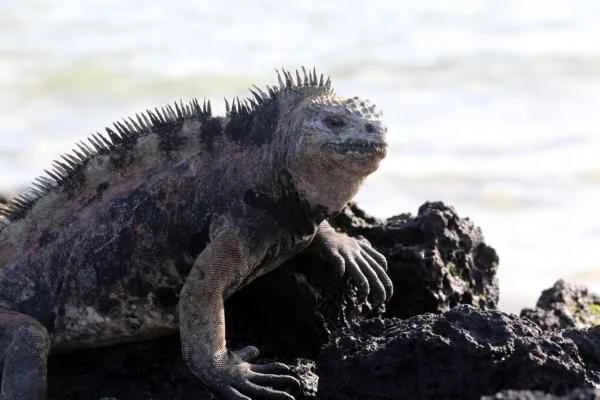
Marine iguanas (Amblyrhynchus cristatus) are the world's only marine lizards, belonging to the iguana family, and are endemic to the Galapagos Islands. On this unique volcanic archipelago, marine iguanas have evolved unique ecological adaptations over a long period of time, becoming the world's only remaining "marine lizards." Both their physiological structure and lifestyle exhibit many amazing characteristics.
Key characteristics of marine iguanas
The only iguana that can dive into the sea to forage : Unlike other terrestrial iguanas, marine iguanas can dive into the sea and use their sharp snouts and teeth to scrape seaweed off rocks for food.
Its entire body is covered with hard scales : these scales are composed of keratin, which can prevent moisture loss and resist the erosion of waves.
Sharp claws : enable them to firmly grip slippery rocks and resist the tides.
Distinct dorsal spines : growing along the spine, more developed in males, who are typically about 70% larger than females.
Excellent swimming and diving abilities : Marine iguanas have semi-webbed limbs and a laterally flattened tail, allowing them to move through the water by undulating their bodies like eels.
Dark body color : predominantly black with red or green streaks, which helps them absorb sunlight and raise their body temperature faster. As cold-blooded animals, they rely on basking in the sun to regulate their body temperature.
It can slow down the heart rate : When diving in cold water, it can reduce the heart rate to decrease heat loss.
Distribution and Habitat of Marine Iguanas
Marine iguanas are endemic to the Galapagos Islands of Ecuador, found only within an area of approximately 500 square kilometers. They primarily inhabit the coastal rocks and intertidal zones of the islands, commonly seen basking and resting, and also nesting in mangrove mudflats and inland sandy areas. Ten known subspecies are distributed across the main islands, including Bartra, Darwin, and Santa Fe, with slight environmental differences between individuals on different islands resulting in variations in size and habits.

Dietary habits of marine iguanas
They primarily feed on seaweed : mainly red and green algae, and when these are scarce, they will also consume brown algae, which are more difficult to digest.
Food acquisition methods are related to age :
Juveniles : mostly forage in the intertidal zone and avoid prolonged immersion in cold seawater.
Adults : They can dive to a depth of 30 meters to forage for food. Females will feed on exposed algae at low tide.
Strong salt regulation ability : Due to the intake of large amounts of seaweed, salt accumulates in the body, and marine iguanas excrete concentrated salt crystals through salt glands in their nasal cavity.
Special adaptations : Some individuals also feed on coastal succulents or halophytes to enrich their diet.

Marine iguana behavior and major threats
Strong tolerance to hypoxia : When diving, one can stay underwater for 5 to 10 minutes, and up to 30 minutes, by reducing metabolism and increasing lactic acid tolerance.
Body plasticity : When food is scarce, bone length will shorten, and it will resume growth when sufficient food is available. This reversible growth is extremely rare in the animal kingdom.
Extremely sensitive to environmental changes : vulnerable to pollution, invasive alien species, and abnormal climate. Currently listed as vulnerable by the IUCN, with two subspecies classified as endangered.
Climate change : El Niño brings about rising water temperatures and reduced nutrients, leading to a massive proliferation of brown algae, which increases the toxicity of food and causes a large-scale death of marine iguanas.
Invasive species threats : such as cats, dogs, rats, pigs, etc., which may prey on young or spread deadly diseases.
Environmental pollution : Ship spills, microplastics, pesticide residues, and human waste can all be deadly.
Marine iguana breeding methods
They reproduce once a year : the exact timing depends on food availability and water temperature.
Reproductive behavior : After reaching sexual maturity, males become more brightly colored and more aggressive, competing for territory and mating with females. A few smaller males attempt to mate by roaming, but the success rate is low.
Egg laying and hatching : After mating, females will dig burrows in sand or volcanic ash within 2 kilometers of the coast to lay eggs, with 1-6 eggs per clutch. After hatching, the larvae feed on adult feces to obtain digestive microorganisms, and begin to forage independently after 2 months.
Conclusion
As a "star species" of the Galapagos Islands, the marine iguana not only represents a miracle of biological evolution but also holds a very important position in global ecological conservation. Strengthening the protection of its habitat, preventing the invasion of alien species, and reducing human interference are key to safeguarding the health of the marine iguana and the Galapagos ecosystem.
References
Dawson, WR., Bartholomew, GA., and Bennett, AF. (1977). A Reassessment of the Aquatic Specialization of the Galapagos Marine Iguana (Amblyrhynchus cristatus). Accessible at: https://deepblue.lib.umich.edu/bitstream/handle/2027.42/137252/evo01083.pdf; sequence=1
Guerra-Correa, E. and Rodríguez-Guerra, A. (2020). *Amblyrhynchus cristatus*. Accessible at: https://bioweb.bio/faunaweb/reptiliaweb/FichaEspecie/Amblyrhynchus%20cristatus
The International Union for Conservation of Nature (IUCN) Red List of Threatened Species. Accessible at: https://www.iucnredlist.org/es
Torres, O. (2017). The world's only marine lizard—the crested cristatus (Amblyrhynchus cristatus). Link: http://revistabionatura.com/2017.02.02.10.html