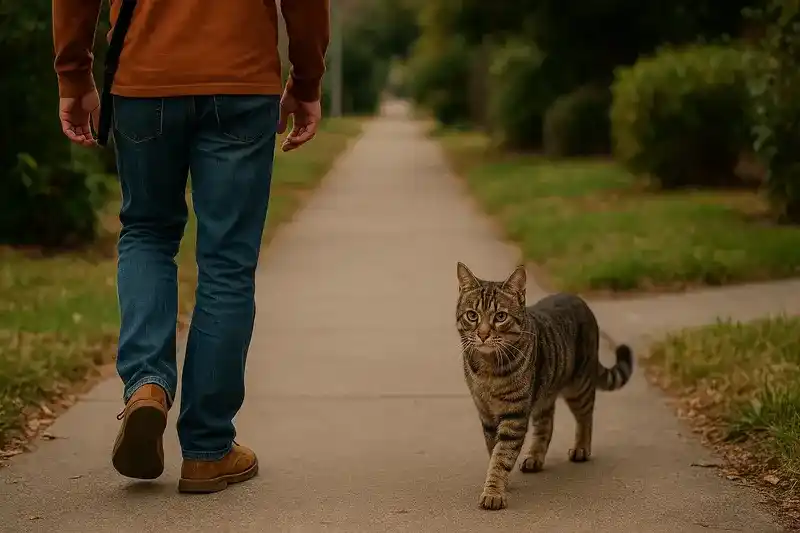
Have you ever experienced this: while strolling down the street or in your neighborhood, a strange cat quietly approaches, not only unafraid of you but also following you, sometimes even meowing as it chases you for blocks? This experience of being "stalked by a cat" is often surprising and intriguing—what does it want? Is it hungry? Or do you possess some quality that attracts it?
As a pet behavior expert, this article will delve into the possible reasons why a strange cat might follow you, from the perspectives of cats' nature, emotions, health, and human behavior, and provide practical advice on how to properly handle this "cat-related" situation.
1. Why do cats follow strangers?
1.1 Curiosity-driven
Cats are extremely curious animals, especially those living outdoors or in a semi-free-range environment. They are particularly sensitive to new people and things. You might just be passing by, but a certain scent, movement, or clothing catches its attention, and it will quietly follow and observe.
1.2 Seeking food
One of the most common reasons why cats follow people is that they're hungry!
If you are holding food, plastic bags, or other items, it may mistakenly assume that you have brought food.
It may have been fed by someone else at some point, forming a conditioned reflex that "seeing humans = having food".
1.3 Loneliness or past experience with human companionship
Some stray cats are actually lost or abandoned pets. They are used to interacting with humans, and when they feel lonely or scared, they will try to approach humans who look "friendly".
1.4 Seeking a mate during estrus
Unneutered cats are extremely active during their heat cycle. Male cats will follow the scent of female cats, and female cats may also show unusual affection towards people.
1.5 Physical discomfort or injury
Some cats will approach humans for help when they are sick or injured, especially if they have been rescued or cared for in the past.
2. What traits make a person more likely to be "targeted" by a cat?
2.1 Moves should be gentle and non-threatening.
Cats are exceptionally sensitive to body language. They are more likely to approach you if you move gently, avoid direct eye contact, and refrain from making noise.
2.2 It has a familiar cat scent.
If you have a cat at home, your clothes and bags may still smell of cats, so to the cat you are a "familiar person".
2.3 A calm and relaxed atmosphere
Cats can "sense" human emotions. Cats are more likely to lower their guard when they are emotionally stable and not nervous.
2.4 Wear soft colors and have a natural body odor.
These kinds of details can also affect a cat's level of affection.
3. What should you do if a strange cat follows you?
3.1 Remain calm and observe first.
Check if the person is wearing a collar or bell, and if there is any owner information.
How do you determine if hair is clean and shiny, and if excretion is normal?
Observe whether it shows signs of anxiety or unease (constant meowing, curling up, or hiding).
3.2 Do not forcibly touch or take away.
Even if a cat seems affectionate, you shouldn't take it away rashly to avoid causing stress or aggressive behavior.
3.3 You can try giving them small amounts of food.
If it continues to follow you, prepare cat food or warm water to test its reaction. If its appetite is normal and it reacts quickly, it indicates that its health is generally good.
3.4 Determine if help is needed
If you suspect your cat is lost, take a photo and upload it to a pet tracking platform or a nearby community group.
If the animal is visibly injured or sick, contact your local animal rescue organization for assistance.
3.5 What if I don't plan to adopt?
Keep your distance and avoid feeding.
You can contact community volunteers or stray cat rescue stations to register your information.
IV. What should I be aware of if I want to adopt this cat?
4.1 Send to the hospital for a medical examination
Confirm the presence of infectious diseases, parasites, and whether sterilization is required, and administer vaccinations.
4.2 Establish a quarantine period
Before officially introducing it into the home, it is recommended to isolate it separately for 7–14 days to avoid infecting other cats in the household.
4.3 Establishing a Trust Relationship
Do not force closeness; instead, gradually establish positive connections through feeding, playing, and touching.
4.4 Assess living conditions
Consider your financial situation, time and energy, and the acceptance level of your existing pets before deciding whether to adopt long-term.
V. Conclusion: A single act of following might be its plea for a home.
Unlike dogs, cats rarely follow strangers. If a cat repeatedly follows you, it may be expressing trust and seeking help through its actions.
Cherish every act of trust from an animal. You can choose to feed it or find it a home. Don't force it or disturb it, but please respect its courage to approach you every time.