Scientific name: *Pantherophis guttatus * | Common Chinese names: Corn snake/Red rat snake <br/>Origin: Widely available through captive breeding , with diverse morphologies, ranging from entry-level to high-end prices. Temperament: docile, easy to handle, highly adaptable. <br/>Ecological value: An efficient rodent killer in the wild, friendly to farmland and storage areas.
On the market, you'll find corn snakes ranging from "beginner colors" to "high-priced rare varieties" (such as Palmetto , Scaleless , Snow , Anery , Amel , Caramel , etc.). They are considered "the perfect choice for beginners" because they are easy to keep, easy to tame, tasty, easy to clean, and easy to handle .
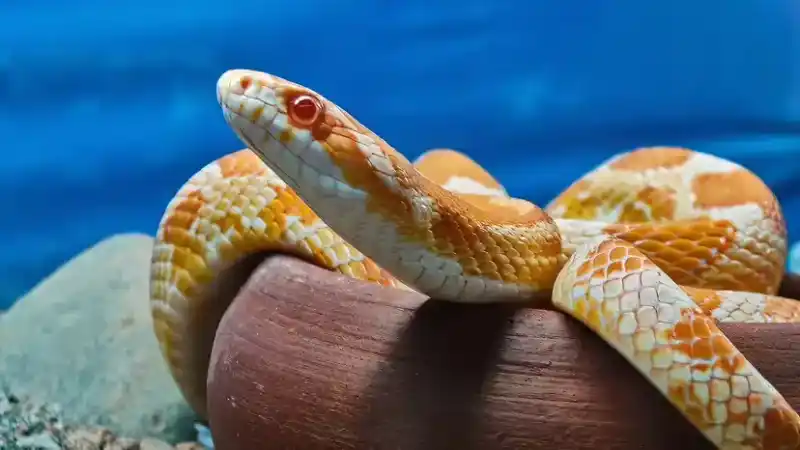
Corn snakes are easy to keep, and the patterns on their scales sometimes resemble variegated corn (sometimes called Indian corn).
I. Species Overview: Distribution, Size and Appearance
Distribution : Native to the southeastern to central-eastern United States (southern New Jersey to the Florida Keys, extending to the Carolinas, Tennessee, Kentucky and the Gulf Coast), it is especially common in abandoned houses, barns, and forest edges and farmland transition zones.
Size : Adults typically measure 90–140 cm in length, less than 170 cm (approximately 5.5 ft) ; smaller than related species such as the Eastern Rat Snake.
Wild coat color : orange-brown base with dark red "saddle spots" on black edges; black and white checkerboard pattern is commonly seen on the underside, which is considered a major source of the name " corn " (another theory is that it is often found in corn silos/fields).
Non-venomous : Like most North American rat snakes, it is non-venomous and kills its prey with **constriction** instead of venom.
II. Corn Snake vs. Copperhead Viper: Don't Mistake It Again!
The copperhead is a common venomous snake in the southeast . It is easily mistaken for the corn snake because both snakes have stripes on their backs.
Quick identification :
| feature | Corn snake (non-venomous) | Copperheaded adder (poisonous) |
|---|---|---|
| Head shape and pupils | Round head , round pupils | Triangular head , vertical slit pupil |
| stripes | Oval/saddle-shaped spots , orange-red base tone | Hourglass-shaped spots , with an overall brownish-copper hue. |
| vigilance behavior | Vibrating tail sweeping blades simulates the sound of a rattlesnake. | True vipers can actively warn and bite. |
Tips: Observe a snake before moving away ; it's safer not to put your hands under grass or wooden boards.
III. Born "Rat Exterminators": The Dual Value of Farmland and Ecology
Prey range : Young snakes often eat tree frogs, lizards, and young mice ; sub-adults/adults include small birds, bird eggs, voles, house mice, and small field mammals .
Ecological role : As a top small rodent control agent , it suppresses rodents around agricultural storage and grain warehouses, reducing pathogens and crop losses.
Humans and snakes coexist : They can often be seen under planks/stones in barns, abandoned houses, and forest edges—this is a delicate balance in their "coexistence with humans".
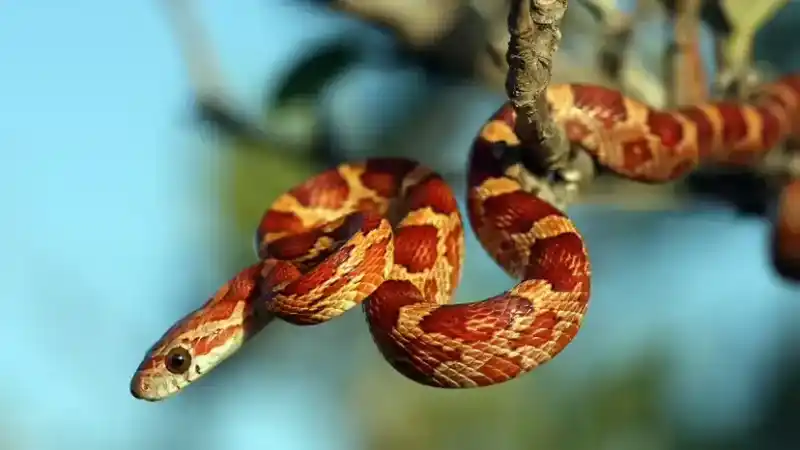
While most corn snakes hunt on the ground, some climb trees to hunt, like this adult corn snake that lives in the southern Florida Keys.
IV. Why is it suitable as the "first snake"?
Good-tempered and tamable : Most individuals are docile and readily accept handling.
Stable diet : High acceptance of frozen-thawed mice (FT) with a low probability of food refusal.
Strong environmental adaptability : It has a high tolerance for temperature and humidity and is not a demanding type.
Suitable size : not too big, nor a "pocket snake"; safe to operate and space-friendly.
A wide variety of designs : from entry-level to high-end and rare pieces , catering to different budgets and aesthetic preferences.
V. Feeding Guide (Easy for Beginners)
1) Equipment and Dimensions
Minimum space for adults : Recommended **40B "lateral" (approximately 90×45×45 cm) or equivalent volume; minimum 20-gallon long box (approximately 76×30×30 cm)**.
Juveniles : Start with a plastic feeding box/small tank with good ventilation ; upgrade as they grow.
Ventilation and safety : mesh/perforated ventilation + escape prevention (corn snakes are "escape masters").
Setup : Concealed hiding places on both sides (one on the hot side and one on the cold side), climbing branches/vines , rough climbing surfaces , water basins (large enough to soak in) , and ground cover .
2) Temperature and humidity
Temperature gradient :
Hot end surface : 28–30℃ (82–86°F)
Cooling temperature : 22–24℃ (72–75°F)
Temperatures may drop slightly overnight , but will not fall below 20°C/68°F.
Heating : Heating pad/heating plate + thermostat or heating lamp ; hot stones are prohibited (risk of burns).
Humidity : 40–60% ; a moistening box (wet moss) can be provided during the molting period.
Sunlight : UVB is not mandatory, but **low-dose UVB (2–5%)** helps with circadian rhythms and overall health; 10–12 hours of sunlight.
3) Bedding and Cleaning
Recommended : Aspen wood chips , coconut shells/coconut fiber , paper towels/newspapers (economical and hygienic).
Avoid : Cedar/Pine wood (volatile oils irritate the respiratory system/risk of liver toxicity).
Cleaning : Remove feces/change water daily , and perform deep disinfection and pad replacement every 2–4 weeks .
4) Feeding and feeding frequency
Food : Frozen and thawed rats (choose the size according to the size of the prey's body ≈ the thickest part of the snake's body ); do not feed live prey to avoid being bitten.
frequency :
Larvae: every 5–7 days
Subadults: every 7–10 days
Adults: every 10–14 days (adjust slightly according to body condition)
Post-feeding management : Avoid handling the animal within 48 hours after feeding to reduce rumination/stress.
5) Hands-on Experience and Behavior
Key points of operation : move slowly, support the abdomen , and do not grab the head ; in the beginning, perform short and repeated movements to establish positive experience.
Refusal to eat/Warning : Short-term refusal to eat may occur when changing environments or during molting, which is normal; pay attention to weight and mental state .
6) Health and Isolation
Frequently Asked Questions :
Respiratory tract infection (RI) : open-mouth breathing, nasal bubbles; requires temperature control and veterinary care .
Stomatitis : Oral congestion/discharge.
Ectoplasm (mites) : Small black dots moving on the body surface.
Incomplete peeling : Improve humidity and moisturize .
Obesity : Control the amount and frequency of feeding.
Isolation : New entrants are isolated for 60–90 days with independent tools to prevent cross-infection.
Lifespan : With proper care, it can live 15–20 years , with records of 30+ years .
Regulatory advice: Check local regulations and permits before purchasing; only choose legally bred individuals and refuse those captured from the wild .
VI. Introduction to Breeding (Brief Overview)
Seasonality : Northern populations often hibernate in the winter (brumation) ; they pair up in the spring.
Egg laying : 10–30 eggs/nest , incubation temperature 28–29℃ , hatching in about 55–65 days (depending on temperature).
Genetics : Corn snakes exhibit a wide range of morphologies, including dominant, recessive, incompletely dominant, and codominant traits. Beginner breeders are advised to avoid inbreeding and to be aware of welfare controversies and breeding ethics surrounding scaleless morphologies .
VII. A list of common morphal colors (excerpt)
Palmetto : White background with random colored dots , unique and rare, high price range.
Amel , Anery , Snow , Caramel , Hypo , Bloodred , Scaleless , **Motley/Stripe**, etc.
Price : Varies depending on genetics, stability, appearance, and market scarcity , ranging from entry-level to high-priced collector's items .
8. Why not "everyone should keep corn snakes"?
Continued investment is still needed : stable temperature and humidity, long-term feeding, regular cleaning, and medical supplies.
Ethics regarding small animals : Feeding rodents should be accepted ( freezing and thawing is recommended to reduce pain and risk).
Family factors : Minors need guardianship ; families with snake phobia or rodent allergies should be cautious.
Shopping list (beginner's guide)
Glass or plastic enclosure (adults recommended size ≥ 90×45×45 cm )
Thermostat + heating pad/heating lamp (hot end 28–30℃)
Thermometer and hygrometer ( two meters recommended)
Two shelters (one on the cold side and one on the hot side).
Climbing branches/vines + water bowl (for soaking)
Substrate (poplar wood chips/coconut fiber/paper)
Frozen mice (sized according to body size) + thawing forceps
Disinfectant products (fragrance-free, safe for reptiles)
Spare isolation box (for use upon arrival or when the person becomes ill).
FAQ (Frequently Asked Questions)
Q1: Do corn snakes bite? Are they suitable for beginners?
A: Most individuals are docile and can be handled . Any snake may bite defensively when startled or treated roughly; gentle handling and proper grip will minimize the risk.
Q2: Do I need UVB?
A: Not essential , but low doses of UVB are beneficial for circadian rhythms, vitamin D synthesis, and overall activity. Maintaining the correct temperature is more crucial than blindly applying strong UV rays.
Q3: Why feed them "frozen and thawed" instead of live animals?
A: Safer (avoids being bitten by rats), more hygienic , more humane , and easier to feed in measured quantities . Thaw until warm and serve with feeding tongs.
Q4: How often should I clean it? Will it smell?
A: Remove feces and change water daily , and perform a deep cleaning every 2–4 weeks . Good ventilation and timely cleaning can significantly reduce odor.
Q5: Can I keep it with other snakes?
A: Cohabitation is not recommended . After the quarantine period, it is still recommended to keep them separately to avoid accidental injury, competition for food, and cross-infection.