Sea turtles are mysterious reptiles that live between the ocean and the coast. Although they are widely known around the world, our understanding of them is still far from complete. Every year, scientists continue to reveal new discoveries about these ancient animals.
This article will take you deep into the world of how sea turtles reproduce, including their mating methods, egg-laying behavior, incubation mechanisms, and sex determination. Whether you are a nature enthusiast or an animal conservationist, this article will unveil the mysteries of sea turtle reproduction.
I. Reproduction methods of sea turtles: sexual reproduction + oviposition
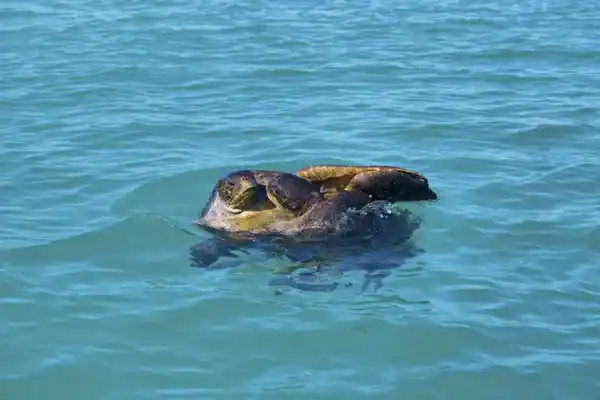
Sea turtles are sexually reproducing oviparous animals, meaning they reproduce by mating, laying eggs, and then incubating them to continue the family line. They do not give birth to live young or be viviparous like some reptiles .
After mating, female sea turtles will go to the beach to build a nest, release fertilized eggs in their oviduct, and bury them in the sand. Afterward, they will cover the nest with sand and immediately return to the sea, without caring for the eggs or offspring.
II. Sea turtle courtship behavior: underwater "chase battles"
Although many mysteries remain about sea turtle courtship, scientists have observed the following common behaviors:
Courtship locations: usually occur in shallow coastal waters near breeding beaches;
Behavioral characteristics: Males will bite the forelimb fins of females, or a group of males will engage in fierce "competition" around a single female;
Objective: To win the right to mate.
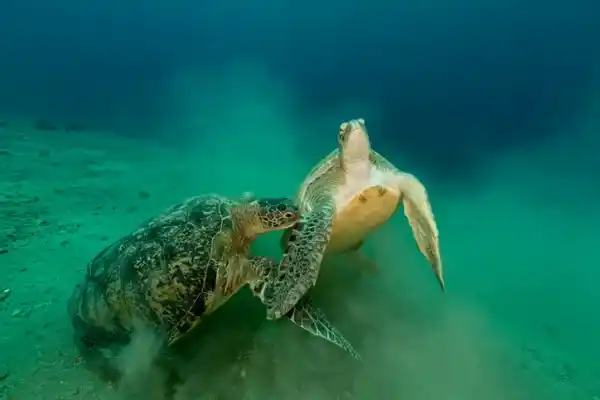
III. The mating process of sea turtles: completed underwater, multiple males at a time.
Once a female accepts a male, she stops, and the male mounts her shell from behind, gripping her tightly with the hooked claws of his forelimbs. The male then fertilizes her internally through the cloaca.
Special note: A female may mate with multiple males during a breeding season, so eggs in a nest may come from sperm from different fathers.
It is worth noting that only female sea turtles return to land to nest; once males leave their birth beach, they almost never return to land.
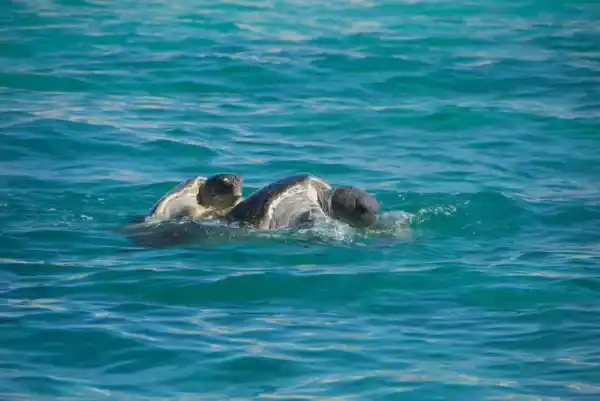
IV. At what age do sea turtles begin to reproduce?
The time when sea turtles reach sexual maturity varies depending on the species, but it is generally quite late:
On average, sexual maturity is reached around age 30 .
Green sea turtles may not live past 50 years old ;
Some individuals can reproduce as early as 17 years old .
This also explains why sea turtles reproduce slowly and have a long population recovery period.
V. Sea turtle breeding season: Varies by location
Different species of sea turtles have different breeding seasons, and even the same species of sea turtle may have different breeding times in different regions.
For example:
Leatherback turtle (Tortuga laúd): Prefers to breed in warm, humid seasons;
Tropical America: February to July;
Atlantic coast of Africa: November to March of the following year.
Loggerhead turtles (Tortuga boba): They breed mostly in early spring, with a more regular breeding cycle.
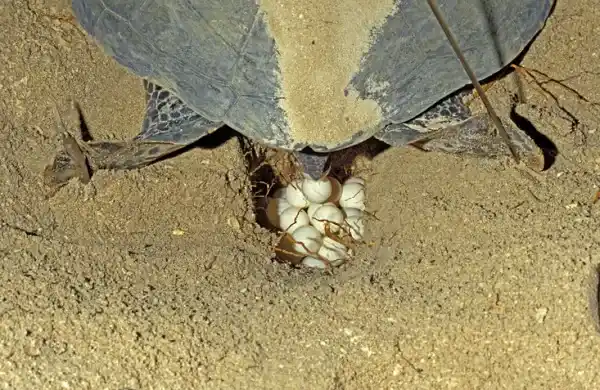
VI. How do sea turtles build nests and lay eggs?
Sea turtle nesting behavior is extremely complex and awe-inspiring. While most sea turtles exhibit **"mother beach homing"**, meaning they return to their birth beach to lay their eggs, some species, such as leatherback turtles, do not always do so.
Factors that may influence the choice of a beach include:
Underwater topography;
The texture and temperature of the sand;
Beach vegetation and rock formations, etc.
The process of a sea turtle laying eggs involves the following steps:
Location selection: Some types will repeatedly select the same location;
Digging nests: Using its fore and hind limbs to dig deep pits in the sand;
Egg laying: Fertilized eggs are laid one by one into the nest through the birth canal;
Bury: Use hind legs to cover the nest again;
Returning to the sea: Once completed, the female sea turtle leaves immediately and never returns, nor does she care for her offspring.
The whole process is extremely arduous. Sea turtles are slow-moving and vulnerable on land, and each time they lay eggs is a huge physiological challenge.
7. How many eggs does it lay each time? This varies depending on the species.
Loggerhead:
Florida: Approximately 100-125 eggs per nest;
Cape Verde/Mediterranean: 65–95;
Green sea turtles: Approximately 110-130 turtles per nest;
Leatherback: Approximately 80-90 turtles per nest;
Some nests may contain only 30 eggs, while others may contain more than 150.
8. 60-day incubation period: Temperature determines sex!
The incubation period is about 60 days on average, but environmental factors such as temperature and humidity can affect the incubation time and results.
The most interesting thing is that the incubation temperature of the egg determines the sex of the sea turtle!
29.5°C is the critical temperature.
Temperatures above this: Most of the offspring born are female;
Below this temperature: most of the offspring will be male;
At temperatures close to this level, the gender distribution is more balanced.
This means that global warming has a significant impact on the sex structure of sea turtles.
9. Why should we not touch sea turtles or their eggs?
Many people get excited and take photos when they see sea turtles hatching, and some even try to help the baby turtles reach the sea. However, these actions are often disruptive or even harmful .
If you find on the beach:
Unhatched eggs;
A baby sea turtle crawling;
Do not touch or move them . Contact your local wildlife conservation agency immediately. For example, in Spain, you can call 112 to request assistance from marine animal rescue centers such as the CRAM Foundation.
They will:
Monitor and protect the nests;
Assist in incubation;
Artificial release if necessary;
Health monitoring and delayed release will be conducted on some individuals.
This can significantly improve the survival rate and recovery speed of the population.
10. Conclusion: Protecting sea turtles starts with understanding.
Every stage of sea turtle reproduction—from courtship to egg-laying, from hatching to reaching the sea—is thrilling yet incredibly fragile. Behind every baby sea turtle that successfully crawls to the ocean lies decades of evolutionary wisdom and countless human efforts to protect it.
If you also want to protect these lovely creatures, you might as well start by learning about them, joining a sea turtle conservation organization, or participating in marine ecological conservation volunteer services.
Further reading recommendations:
[Sea turtle species and distribution]
Why are sea turtles on the verge of extinction?
[Participating in a Volunteer Project: How to Help Wildlife]
Please indicate the source if you wish to reprint this article, and you are welcome to follow our animal science column.