When you come home after a long day and are ready to lie down on your soft, comfortable bed, only to find that your cat has "surprised" you on your sheets—this is a moment of despair and confusion for many cat owners. Aren't cats born knowing how to use a litter box? Why would it urinate on the bed? Is it angry, retaliating, or is there something wrong?
As a pet behavior expert, I will provide a comprehensive analysis of the possible reasons why cats urinate on the bed from multiple perspectives, including physical health, psychological state, environmental factors, and feline instincts, and offer scientific and effective coping strategies.
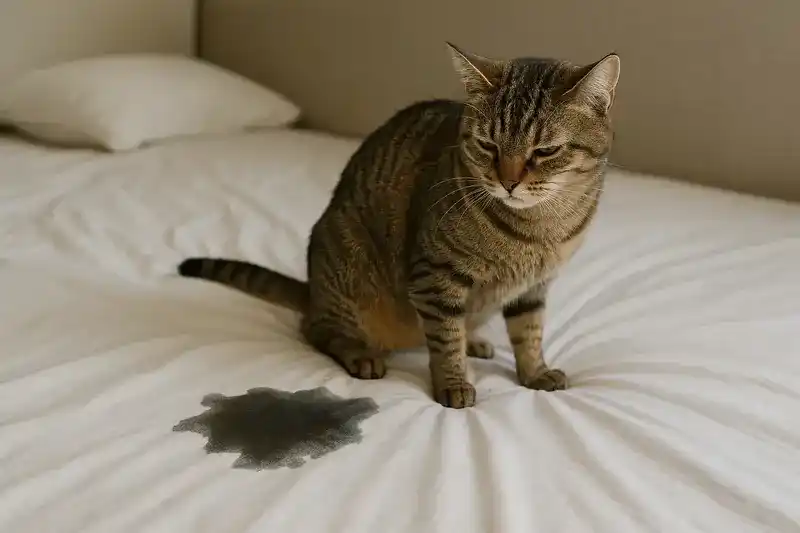
1. Physiological reasons: The cat may genuinely be "uncomfortable".
1.1 Urinary tract infection (UTI)
Frequent urination in cats, especially in unusual places, is often a sign of urinary tract infection or inflammation, particularly in female cats and older cats.
1.2 Bladder stones or cystitis
Blood in urine, frequent trips to and from the litter box with low urination volume may indicate discomfort caused by a urinary tract infection.
1.3 Chronic kidney disease and diabetes
These types of chronic diseases can cause cats to urinate frequently and become incontinent, especially while sleeping.
1.4 Pain leads to difficulty in movement
Arthritis or other pain issues may make cats reluctant to jump around in and out of the litter box, opting instead to relieve themselves on the nearest soft surface.
Recommendation: If your cat suddenly changes its urination habits, you should take it to the veterinarian immediately for a physical examination, urine test, and blood test.
II. Behavioral and Psychological Factors: What are cats "expressing"?
2.1 Stress or anxiety
Moving, new pets, new family members, and visits from strangers can all cause anxiety in cats, leading to "marking" behavior.
2.2 Lack of security
The bed, which carries the scent of its owner, is a "safe zone" in a cat's mind, where it may choose to urinate to seek comfort and familiarity.
2.3 Separation Anxiety
Some cats are extremely dependent on their owners, and when their owners are away from home for a long time, the cat may try to "find you" by urinating on the bed.
2.4 Possessiveness and Territory Marking
Cats that are not spayed or neutered may urinate on the bed to declare "you are mine," which is a typical territorial marking behavior.
3. Litter box factor: It's not the cat's problem, it's that the "toilet" isn't good enough?
3.1 The litter box is too dirty
Cats are extremely sensitive to cleanliness; if the litter box is not cleaned in time, they will rather relieve themselves elsewhere.
3.2 Dislikes the type of cat litter
Some cats dislike scented, coarse, or sticky cat litter.
3.3 Insufficient quantity or improper placement
Multi-cat households should have at least one litter box for the number of cats plus one, and it should be placed in a quiet and secluded location.
3.4 The litter box is too small or the edges are too high.
Older cats or cats with joint problems may have difficulty crossing high sides.
IV. Instinct and Habit: Soft Spots, Natural Temptations?
4.1 The soft, absorbent material is "too comfortable"
Cats may use soft materials such as sheets and clothes as ideal places to defecate, especially kittens before they have developed a fixed toilet habit.
4.2 Leave an odor mark
Cats communicate through scent. Some cats "add" their own scent to familiar or favorite places to strengthen their sense of belonging.
5. How to correct a cat's behavior of urinating on the bed?
5.1 Thorough cleaning
Use a specialized enzyme-based cleaner to remove urine molecules and prevent residual odor from stimulating the cat to repeat the behavior.
5.2 Restricting access to the bedroom
Before the behavior improves, close the bedroom door and physically isolate the individual.
5.3 Changing the type of cat litter and the location of the litter box
Try using fine, odorless cat litter; place the litter box in an area your cat likes to linger in.
5.4 Providing alternative comfort points
Provide your cat with soft mats and cat beds as "alternative beds," and enhance interaction and companionship.
5.5 Sterilization surgery
Unneutered cats are more prone to marking behavior, so it is recommended to have them spayed or neutered at the appropriate age.
5.6 Behavioral Modification and Reward Mechanisms
Use positive reinforcement: reward and praise the cat every time it successfully uses the litter box.
VI. Conclusion: Behind their behavior, cats are conveying messages.
When a cat urinates on the bed, it's almost never a case of "deliberate revenge," but rather the result of a combination of factors, including health, stress, and environment.
As owners, our role is not to blame, but to understand and improve. When you are willing to see things from your cat's perspective, check and adjust step by step, the problem can be solved.
Remember, cats speak through their actions, and you are their closest "listener".